

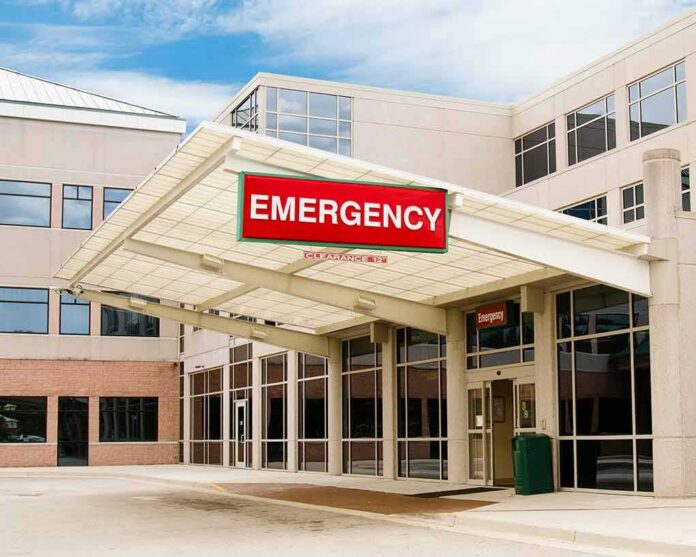
More than a million older people in England now spend half a day or longer stuck in Accident and Emergency, turning the place that should save their lives into a holding pen of pain and neglect.
Story Snapshot
- Over 1 million patients aged 60-plus waited 12 hours or more in A&E last year
- For people aged 90 and over, about one in three now face a 12-hour wait
- Some elderly patients are left in corridors for up to three days before getting a bed
- Experts say this points to deep failures in hospital flow and social care support
What the numbers say about growing delays
England’s emergency departments have quietly crossed a line most people never imagined: twelve-hour waits are no longer freak events, they are routine. Freedom of Information data used by the Royal College of Emergency Medicine shows more than 1.15 million people aged 60 and over spent at least 12 hours in major A&E units in 2024–25 before being admitted, discharged, or transferred. The chance of such a long delay jumps with age. For those in their sixties it is about 15 percent; by age 90 and above it rises to roughly one in three.
This is not just a problem for a few unlucky patients. A British Broadcasting Corporation analysis found around one in ten people attending major A&E departments in 2025 faced a 12-hour wait, adding up to about 1.75 million individuals. That is a national pattern, not an isolated scandal. Official statistics now show repeated spikes in extreme waits each winter, with records broken in January 2024, January 2025, and January 2026. Pre-pandemic, monthly counts of 12-hour waits were usually in the tens or low hundreds. The system has moved into a different, much harsher reality.
Older patients bear the brunt of corridor care
Behind these big numbers sit real people in their seventies, eighties, and nineties, parked on trolleys and chairs in busy corridors. Age UK’s corridor-care analysis, again based on Freedom of Information requests, found more than 100,000 cases in a single year where patients aged 65 and over waited between one and three days in A&E after staff had already decided they needed a hospital bed. Some were reported lying on the floor or washing in toilet sinks while they waited. Another set of data shows nearly 150,000 people aged 90 and above now face 12-hour waits in A&E each year, many in hallways.
Professional bodies have stopped using gentle language. The Royal College of Emergency Medicine has called five-day waits for people over 65 “a national shame.” In trusts that provided detailed figures, almost two-thirds of patients who waited more than 12 hours after a decision to admit were aged 65 or older. Age UK estimates that about two-thirds of all twelve-hour A&E waits are now experienced by people over 60. When the longest delays mostly hit those least able to cope physically, common sense says the system has lost control of its priorities.
The safety risk and human cost
Long waits are not only miserable, they are dangerous. Age UK’s research highlights evidence that people who spend more than 12 hours in A&E are more than twice as likely to die within 30 days as those who are seen within two hours. A Kent hospital recently linked a surge in twelve-hour waits to higher deaths, recording more than 1,300 such waits in a single month in 2026. That is exactly the pattern conservatives worry about: when a government-run system becomes so overloaded that basic safety falls apart.
Lot of waste/inefficiency in the system, eg:-
UK-wide, roughly 40% of ambulance calls do not warrant an emergency response.
NHS England: Roughly 40% of A&E attendances are preventable.
Health tourists cost at least £300m (probable under estimate)
Etc, etc
We mistreat the NHS!— Alan 'Alfie' Spaletto (@TestingTime17) July 30, 2026
The stories match what any older reader may have seen first-hand. People with chest pain left on plastic chairs. Frail patients who cannot walk kept on trolleys in bright corridors overnight. Families told “there are no beds” even after a doctor has decided their relative needs urgent admission. These are not the small annoyances of a busy service. They are signs of a deep failure to protect those who paid taxes for decades and now need the system to work for them.
Why this points to systemic failure, not bad luck
The pattern of extreme waits gives clues about the underlying problem. The spikes occur when hospitals cannot move people out of A&E into wards because beds are already full. The Nuffield Trust’s analysis shows that by January 2026, about 13 percent of emergency admissions waited more than 12 hours after the decision to admit. That kind of backlog cannot be explained by a few slow doctors or one rough flu season. It points to blocked ward capacity and poor flow across the whole hospital.
Older patients are more likely to need complex support before they can safely go home. Age UK’s wider work on “urgent and emergency care and flow” stresses that a lack of social care packages and community support keeps medically fit older people stuck on wards, which then keeps new emergency patients stuck in A&E. That fits with a conservative view that when the state promises cradle-to-grave care but fails to fund or manage it well, the people who suffer most are the quiet, law-abiding citizens who rely on that promise late in life.
What this means for policy and for families
For policymakers, the message is blunt. Adding more A&E staff alone will not fix twelve-hour waits if hospitals cannot free up beds and social services cannot support discharge. Emergency doctors are now openly saying that long trolley waits have “become the norm” in too many places. That suggests a chronic structural problem, not a temporary crisis. A serious response must tackle bed numbers, care home capacity, and home-care support together, or the next winter peak will simply set another record.
For families, the reality is harsh but clear: if you are over 80 and end up in A&E in England, your chance of a very long wait is now high. Planning ahead matters. Knowing which hospitals are less pressured, insisting on updates, and pushing calmly but firmly for basic dignity – a chair, a blanket, access to a toilet – can make a bad situation slightly less dangerous. The bigger fix is political, but the immediate fight for respect and safe care happens one corridor at a time.
Sources:
independent.co.uk, theguardian.com, rcem.ac.uk, bbc.com, caremark.co.uk, ageuk.org.uk, news.sky.com
© ournationnews.com 2026. All rights reserved.