

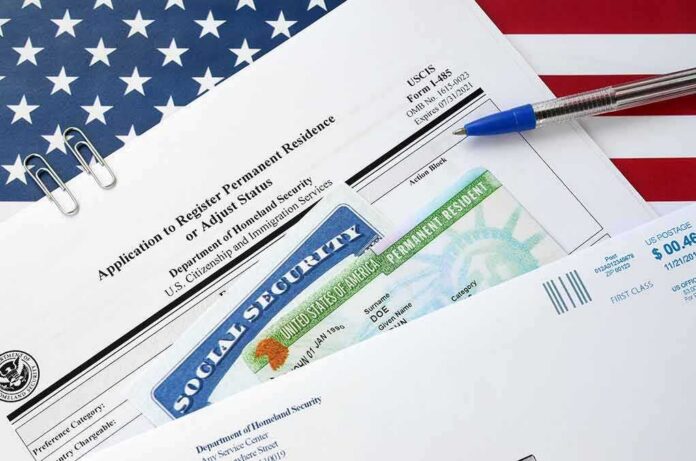
New Jersey just wrote a $20.2 million check to fund deportation defense, and the battle over priorities exploded on cue.
Story Snapshot
- The state formally allocated $20.2 million for immigration legal defense across 10 providers.
- Governor Mikie Sherrill framed the move as a due process guarantee for low-income residents.
- Funding more than doubled from the prior cycle, citing rising demand for counsel.
- Republican leaders blasted the spend as wrong while families face high costs.
The concrete facts of the $20.2 million allocation
The New Jersey Department of Human Services announced $20.2 million for immigration legal services, distributed to 10 providers that handle detention and removal defense for low-income residents. The state described this as an expansion of an existing initiative, not a new experiment, and said the funding ensures access to counsel for detainees at Delaney Hall who qualify based on income. The awards went to a mix of legal aid groups, faith-affiliated charities, and university law programs named in coverage of the rollout.
Governor Mikie Sherrill tied the expansion to a simple due process claim: people in removal proceedings deserve a fair hearing with legal help, regardless of where they were born. That message matches a long-standing access-to-counsel debate, where representation rates for detained people have lagged far behind other court systems. The administration positioned the funding as a guardrail against rushed or flawed proceedings, not as a promise of outcomes for any one case.
How this differs from a pilot and why that matters
The program builds on a prior initiative launched under the previous administration and now scaled up by $12 million to reach $20.2 million total, more than doubling the last cycle’s amount according to multiple reports. That continuity matters for implementation. Providers already screen clients, meet detainees, and manage cases through federal immigration courts. Existing networks reduce startup lag but also raise fair questions: how were awards sized, what caseloads are forecast, and how will the state track results per dollar spent? The public record does not yet answer those points.
Coverage listed recipient organizations including Legal Services of New Jersey, American Friends Service Committee, Seton Hall University School of Law, Rutgers University School of Law, the Office of the Public Defender, Church World Service, the New Jersey Consortium for Immigrant Children, Catholic Charities of the Archdiocese of Newark, and the International Rescue Committee, among others. That mix signals capacity across detention intake, bond hearings, appeals, and community navigation. It also invites scrutiny from skeptics who view advocacy-linked grantees as ideological or financially interested stakeholders in the program’s growth.
The affordability backlash and the conservative test
Republican critics attacked the spend as misplaced while families face high electric bills, steep property taxes, and a rising cost of living. Representative Jeff Van Drew said every dollar for deportation defense is a dollar not spent helping New Jersey residents afford to stay in the state. State Senate Minority Leader Anthony M. Bucco argued that schools weigh cuts to basics while the governor found $20 million for this program, calling it the wrong priority. These objections track core conservative values: focus on taxpayers first, measure results, and fund essentials before extras.
UPDATE: New Jersey just officially distributed the $20.2 million for the Detention and Deportation Defense Initiative (DDDI).
Back in August, I noted the 4 core legal defense teams receiving taxpayer funding to prevent the deportation of noncitizens. With the state's newly… pic.twitter.com/ZDEvTczZQj
— iDenville (@iDenville) November 16, 2026
The administration’s case rests on process fairness, not a promise to block removals. That premise has legal weight but needs hard metrics to justify the scale. The state has not publicly supplied performance data such as cases handled, representation rates, wait times, success on relief, detention days reduced, or cost per client. Common sense says big checks need clear scoreboards. If the program cuts needless detention days, speeds case resolution, or reduces in-absentia orders, show it. If not, taxpayers will rightly question the return.
What to watch next: proving value or shifting course
Three facts will decide how this lands with voters. First, whether all low-income detainees at Delaney Hall who seek counsel can actually get a lawyer, as the state suggests. Second, whether providers can publish credible, audited outcomes that link funding to measurable improvements. Third, whether the increase reflects real caseload pressure, not a political gesture; the state cited rising enforcement but did not publish detention counts or filing forecasts to support the $12 million jump. If those gaps close, the spend will stand taller; if they do not, expect the affordability hammer to keep swinging.
Sources:
twitchy.com, nj.gov, nj.com, foxnews.com, breakingac.com, newjerseymonitor.com, yahoo.com
© ournationnews.com 2026. All rights reserved.