

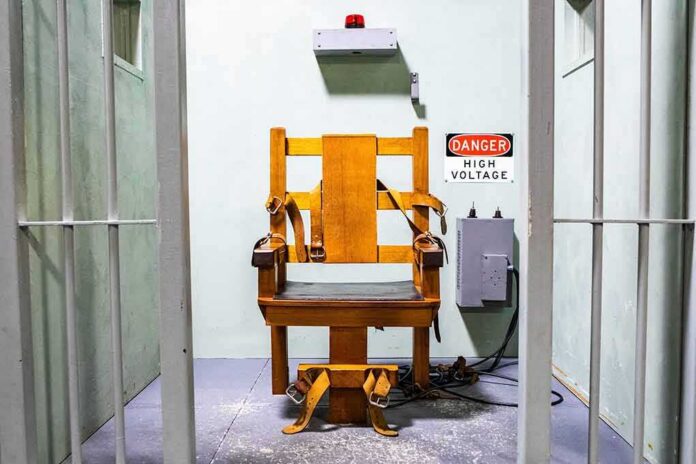
A death sentence stalled after two lethal injections, and Tennessee’s governor hit the brakes on every other execution to find out why.
Story Snapshot
- Officials tried twice to execute Christa Pike, then sent her to a hospital.
- Governor Bill Lee ordered a third-party review and paused executions for 2026.
- The Department of Correction said staff followed the state’s approved protocol.
- Witness and defense accounts described loud breathing and a chaotic scene.
What Tennessee Says Happened And Why It Matters
Tennessee officials began the execution of Christa Pike, then told the state’s high court she was being transported by ambulance for medical care. The Department of Correction said the team followed every step of the state’s approved protocol. That statement signals the core issue: if staff did what the manual says, then the manual or its training may be the problem, not just the people. Governor Bill Lee ordered an outside review and halted other executions, which is the sober response a constitutional system demands.
Media witnesses and Pike’s lawyers said two doses of pentobarbital were given and Pike remained alive and snoring. They described starts and stops, closed curtains, and confusion in the chamber. Those claims cut against the department’s confidence that the protocol worked as written. The gap between the official line—“we followed the rules”—and the in-room accounts—“it was a mess”—is exactly why an independent audit is necessary. Conservatives should welcome sunlight that fixes the process rather than politics that fuels repeat failures.
The Legal And Ethical Stakes Of A Failed Execution
The United States Supreme Court allowed the state to proceed that night, and the Tennessee Supreme Court had set Pike’s date after years of appeals. Courts have long held that a failed attempt does not, by itself, bar a later lawful execution. The key is whether the method and conduct meet the Constitution’s ban on cruel and unusual punishment. That standard requires reliable drugs, trained staff, and clear steps. When any of those waver, the state risks both litigation losses and moral authority.
Tennessee’s own history shows why this audit cannot be cosmetic. The state paused executions in 2022, ordered an independent review, and shifted to a single-drug pentobarbital protocol in 2024 to reduce error points. The move aimed to simplify a complex process and align with what courts have upheld elsewhere. If a simplified, court-tested method still leads to this level of breakdown, then the failure likely sits in execution readiness: drug quality and handling, intravenous access, live decision-making, and command and control during stress.
Operational Questions The Review Must Answer
Reviewers should test one core chain end to end: drug sourcing, storage, and potency; vein assessment and placement skills; redundancy for difficult access; and crisis triggers that stop the process fast and safely. Witness accounts suggest curtains closed and reopened while Pike made loud breathing sounds. That detail points at a breakdown in real-time checks and communications. A disciplined protocol has timers, verifications, and a single on-scene authority to avoid hesitant toggling that undermines both dignity and certainty.
Tennessee failed to carry out an execution TWICE in 4 months.
❌ May 21: Tony Carruthers. They spent over an hour trying and failing to get a backup IV in. Called off.
❌ Sept 30: Christa Pike. Two doses of pentobarbital. She ended up in a hospital.
Lethal injection already…
— Kentucky Girl (@Kentuckygirl1) October 1, 2026
Training must also be more than scripts. Monthly rehearsals that skip actual intravenous practice, even on lifelike trainers, teach muscle memory without the one skill that matters most. The state’s last review cycle promised better preparation and clear manuals. The audit should now measure who was qualified, how recent their hands-on training was, and whether the team had a field-tested plan for difficult veins. A checklist means little if the team cannot execute under pressure with the right tools and leadership.
What Responsible Leadership Looks Like Now
Governor Lee’s pause and call for a third-party review is the right first step. Next steps should be public, time-bound, and tough on details: publish the findings, name the fixes, retrain staff to a measurable standard, and certify drug integrity through independent labs. If the process cannot meet that bar, the state should not schedule another execution until it can. That stance respects victims, holds government to account, and protects taxpayers from lawsuits born of sloppy administration.
Some will argue this event proves capital punishment cannot work. Others will say press on and minimize the drama. Both miss the mark. The job of a conservative government is not to signal, but to perform. The death penalty remains lawful. If the state chooses to use it, the state must carry it out with competence, transparency, and restraint. Tennessee promised a modern, reliable protocol. The only acceptable outcome of this review is proof that promise can be kept—or the humility to stand down until it can.
Sources:
redstate.com, theguardian.com, abcnews.com, bbc.com, newschannel5.com, yahoo.com, fox5atlanta.com
© ournationnews.com 2026. All rights reserved.