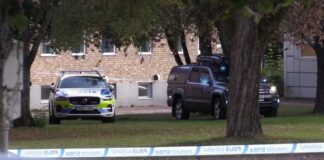

A teenager blew through an airport fence, slammed a parked plane, and the runway still stayed open.
Story Snapshot
- State police say a fleeing driver crashed through a perimeter fence and hit a parked plane.
- Airport leaders reported heavy aircraft damage but no impact on operations.
- No other injuries were reported; the suspect was taken into custody and evaluated.
- Officials identified the suspect as 17-year-old Wyatt Seely of Rochester, New Hampshire.
Police pursuit barrels into airport operations area
New Hampshire State Police reported a pursuit of a black 2008 Ford Mustang that ended at Portsmouth International Airport on Saturday, August 29, 2026. The driver fled a trooper’s attempted stop, broke through a perimeter fence, and struck a parked aircraft on the airfield, according to the agency’s public statement and local reporting that quoted it. The Federal Aviation Administration said a vehicle hit a parked Pilatus PC-12 at the airport that afternoon and referred further questions to local officials.
Airport manager John Meehan said the single-engine aircraft suffered extensive damage, yet the airport stayed open and did not halt operations during the emergency response. That outcome matters. Crews had to secure an active airfield, safeguard aircraft and fuel areas, and clear debris, all while keeping flights moving. That is a tightrope. It points to disciplined airfield command and a security plan drilled often enough to work when a car is loose on the ramp.
Custody, charges, and what police say about the driver
Troopers took the driver into custody and brought him to a hospital for evaluation, according to multiple outlets that cited police. Authorities identified the suspect as Wyatt Seely, 17, of Rochester, New Hampshire, and listed charges that included aggravated driving while intoxicated and reckless driving, with more counts possible as the investigation proceeds. Reporters also noted officials had not detailed why the original stop was initiated at the time of early coverage. The teen’s legal process will determine the final slate of charges and penalties.
Several reports added that the car also struck a Kubota tractor before the plane. The Federal Aviation Administration’s brief incident note did not mention a tractor, while some local coverage did. That detail sits in select reporting rather than the federal summary, but it does not change the core point: a civilian car reached the air operations area and hit an aircraft on the ground. No other injuries were reported by officials on the scene and in follow-up coverage.
Why breaches like this keep happening at U.S. airports
Airport perimeter breaches are uncommon when measured against daily flight counts. They still recur often enough to rank as a known risk in aviation safety work. An Associated Press review found hundreds of breaches at major United States airports over roughly a decade, from fence jumps to vehicle rammings, with some intruders reaching aircraft. Federal Aviation Administration records and industry research track these cases because concrete, vehicles, and airplanes mix poorly on a ramp or taxiway. The goal is not zero incidents; it is fast containment.
Ground collisions come from many causes. Some involve errant aircraft. Some involve airport vehicles with stuck pedals or faulty parts. Others come from people who should not be airside but find a way in. Each pattern calls for a different fix: hardened fencing, better gate controls, faster interdiction, and clear radio protocols once a breach is detected. Portsmouth showed another important layer: keeping operations moving when safe to do so, rather than turning one crisis into a cascade of flight disruptions.
Security, accountability, and common sense next steps
Local leaders will now weigh two tracks: the criminal case and the security review. Prosecutors will press charges that fit proven facts. Airport and police officials will walk the fence line, study camera coverage, and tune gate-hardening and patrol patterns. The American common sense standard here is simple: consequences for dangerous acts, and systems that make a repeat less likely. Both protect travelers, crews, and taxpayers who fund these facilities.
A teenage drunk driver, a police chase, and a crash through the fence at the airport in Portsmouth, NH before the car crashed into a plane and tractor had all the elements of a chaotic time.
I wonder if he will have his license revoked.
I am just glad that the driver wasn't…— lori (@60_Lori) August 31, 2026
Airports cannot become fortresses that choke the travel economy. They also cannot shrug off repeated breaches. The balance is smart risk control. That means quick detection, rapid response, and design that slows a rogue driver long enough for police to stop them. Portsmouth’s team kept the field open after a car hit a plane. That is competence under stress. The next test is whether the fixes that follow make “next time” less dramatic—and shorter.
Sources:
nypost.com, bostonglobe.com, wfmd.com, x.com, nbcboston.com, portsmouthnh.gov, foxnews.com, faa.gov
© ournationnews.com 2026. All rights reserved.





![🇺🇸 First Lady Melania Trump Unveils New Fostering the Future & IndyCar Scholarships [LIVE]](https://ournationnews.com/wp-content/uploads/sites/26/2026/08/maxresdefault-43-218x150.jpg "Melania Speaks Out Amid Trump Aide Rumors")