

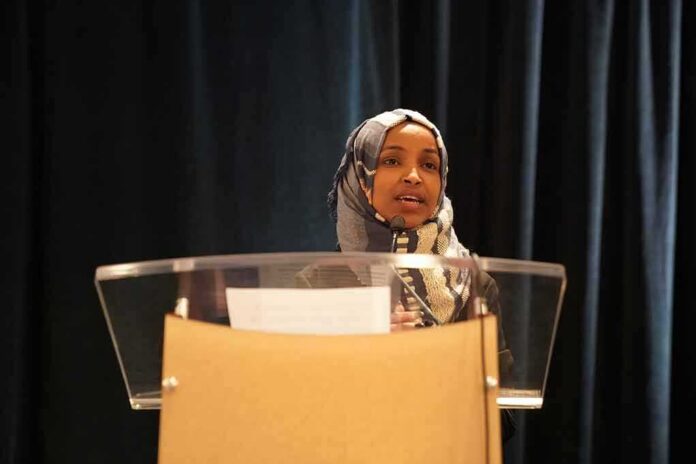
A sealed federal filing reportedly names the congresswoman as Ilhan Nur Said Elmi, also known as Ilhan Abdullahi Omar—and that single line set off a legal and political earthquake.
Story Snapshot
- A federal investigation into old immigration paperwork cites two names for the same person.
- Fox News reported sources saying “Ilhan Omar” is not her birth name; her office flatly denies it.
- The filing’s “also known as” tag signals association, not proof of fraud, but raises stakes.
- Agents executed a court-approved search as part of the probe, confirming real federal action.
What investigators actually did and why it matters
Homeland Security Investigations executed a judicially approved search warrant linked to a probe of decades-old immigration paperwork tied to the congresswoman. The warrant cited possible offenses like conspiracy, false statements, and immigration fraud, according to reporting on the sealed materials. Reuters also reported that the Justice Department confirmed the search occurred, moving this out of rumor and into verifiable law enforcement activity. That confirmation anchors the story in action, not chatter, and explains why the name dispute now matters beyond internet claims.
A separate report described a federal court filing that identified the lawmaker as “Ilhan Nur Said Elmi, also known as Ilhan Abdullahi Omar.” That phrasing shows investigators linked both names to one subject in an active matter. An “also known as” label can cover many things: a legal name change, transliteration, a former married name, or an alias. The label itself does not prove fraud, but it tells you prosecutors think the name issue is relevant enough to put in front of a judge.
The claim, the denial, and the line between them
Fox News reported that two sources familiar with the investigation, including a law enforcement source, claimed the congresswoman’s birth name was Ilhan Nur Said Elmi. The same report quoted a source saying, “That’s not her real name.” Her spokesperson answered in plain terms: “This is completely false. Ilhan Omar is her real name,” and said she has denied this “baseless” theory many times. That is the clear clash: unnamed sources claiming an alternate birth name versus an on-record denial from her office.
Supporters of the claim point to the court filing’s two-name designation and the federal search as signs of substance. Skeptics point out no charge has been filed, and no authenticated birth certificate, refugee file, or passport record has been released to the public showing the Elmi name as original fact. On this narrow point, common sense and conservative prudence align: treat the filing as a serious breadcrumb, not a verdict. If the evidence exists, due process will surface it.
What “also known as” could mean in immigration law
Immigration and citizenship cases turn on material truth. If someone used a different name on key forms, the question becomes whether that difference hid something important. The Supreme Court has drawn lines around materiality in false statement cases, and the Department of Justice has denaturalized people who lied about core facts, like identity or serious crimes. The government has also brought denaturalization actions in clusters when it believes fraud tainted the process. The name alone is not the issue; the intent and effect on benefits are.
One USCIS Certificate of Nonexistence of Record (issued September 6, 2023, by the National Records Center and signed by Douglas C. Marr) states that a diligent search of the Central Index System and Microfilm Digitization Application System found no naturalization record for Nur…
— Durwin Lloyd, ND (ret) (@LloydDurwin) October 22, 2026
Civil records can be messy, especially from war-torn regions where birth documents are scarce or lost. The congresswoman has said she lacks a birth certificate, which complicates record-matching and translation questions that the government sometimes faces with refugees. Separate reporting about a disputed birth year shows how one mismatch can fuel many claims, even when a state library entry says the correct year is 1982 and calls 1981 listings wrong. Not every mismatch equals fraud; the law asks whether a falsehood was willful and material.
Where this goes next—and what would settle it
Three things would clarify the truth. First, release of redacted court records that explain why the filing used two names and what proof supports that association. Second, authenticated immigration and naturalization documents from the 1990s and 2000 that show which names appeared on which forms and when. Third, any forensic tie—biometrics, contemporaneous photos, family composition, and sworn testimony—that links or splits the two names at the time of entry and naturalization.
Expect both sides to frame each new detail as a win. That noise does not change the test. If prosecutors can show knowing, material misrepresentations, the case could move toward charges or civil denaturalization steps, as in other identity cases the government has brought. If the record shows translation drift, legal name change, or non-material discrepancies, this will look like a hard problem made hotter by politics. Let the evidence, not the volume, decide.
Sources:
twitchy.com, reuters.com, timesnownews.com, nypost.com, lrl.mn.gov, thegatewaypundit.com, m.dailyadvent.com, justice.gov
© ournationnews.com 2026. All rights reserved.