
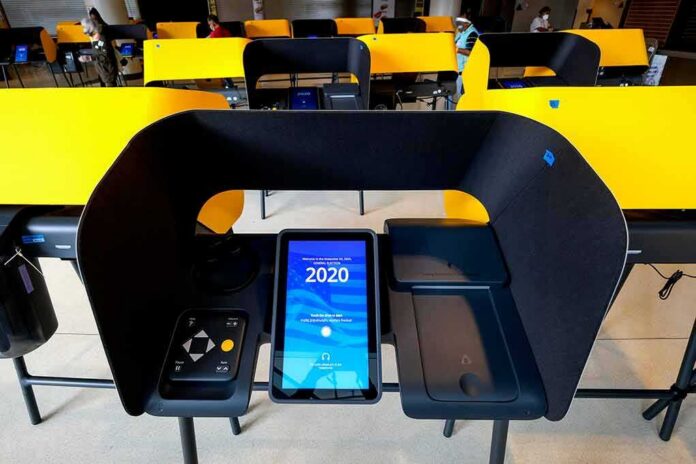
Stella Parton says a Nashville voting machine kept flipping her ballot to Marsha Blackburn—three times—before she could fix it.
Story Snapshot
- Stella Parton alleges a touchscreen kept selecting Marsha Blackburn at a Nashville library.
- State election officials say such mismatches are usually unintended touches, not “vote flipping”.
- Tennessee cites multiple ballot checks: selection screen, review screen, and a printed record.
- Officials report one related complaint out of about 400,000 early ballots cast so far.
A named claim, a specific place, and the question voters always ask
Stella Parton, sister of Dolly Parton, says she voted at the Hermitage Library in Nashville and saw her choice switch to Republican Senate candidate Marsha Blackburn each time she tried to pick another candidate. She says she corrected it three times before printing and casting her ballot. The claim is concrete: a named voter, a known site, a specific race, and repeated attempts. That level of detail grabs attention because it is testable and easy to picture happening.
Tennessee’s top election staff answered fast. Coordinator of Elections Mark Goins said this is not a machine “flipping” a ballot. He said these events almost always come from an unintended touch on the screen. Voters sometimes brush a nearby box without noticing. He stressed that poll workers can help and that machines include checks to catch mistakes before a ballot is cast. That explanation matches prior years when touchscreens drew similar complaints.
How the safeguard steps work when a screen surprises you
Here is the path every voter sees. First, the selection screen lets you pick a candidate. Next, a review screen shows all your choices. Finally, the system generates a paper record for you to inspect before you cast it. If anything on the review screen or the printed ballot looks wrong, you can back up, fix it, or ask a poll worker to spoil and replace the ballot. These steps aim to match the ballot to the voter’s intent at the end.
Officials point to outcomes, not anecdotes. They note that across roughly 400,000 ballots already cast, they have one complaint logged that fits this description. That does not prove every screen touch is clean. It does show the reported rate is low so far. The office also says bipartisan technicians—one Republican and one Democrat—inspect any device reported with a problem, which builds trust for both sides.
Where the facts are firm—and where they are not
Two facts are firm. Stella Parton says her touchscreen switched her pick three times at the Hermitage Library, and she warned others to check their review screen and paper printout. State officials say most such issues come from stray touches, and they have not tied her case to a confirmed malfunction or user error yet. The cause remains unconfirmed. The system, however, is designed so the review screen and paper record control the final vote that gets counted.
Claims of “rigging” demand evidence that survives scrutiny. The more persuasive case shows a wrong final ballot or a mismatch between paper records and reported tallies. This story centers on a screen selection before casting, which the safeguards are built to catch. On the measure that matters—what got cast—Tennessee stresses the voter can stop, fix, and confirm before finishing. That is the common-sense line American conservatives defend: verify, then trust.
Practical rules for voters who want ironclad certainty
Tap slow and centered on the candidate name, then pause to see the highlight move. Use a fingertip, not a knuckle or nail. Study the review screen for every race before you proceed. Read the printed ballot or paper record, line by line. If anything is off at either step, raise your hand. Ask a poll worker to back up the screen or to spoil and replace the printout. Those actions fix the ballot before it enters the count.
Dolly Parton's sister claims Tennessee voting machine changed her vote to Republican pic.twitter.com/9rZHVXswen
— EYEWITNESS NEWS (@cnyhomepage) October 23, 2026
The bottom line is simple and strong. One voter made a detailed claim about a confusing screen. The state gave a direct answer and pointed to built-in checks. The count hinges on what you cast, not what flickers on a touchscreen for a second. Slow down, confirm on the review screen, confirm on paper, and then cast. That habit, repeated millions of times, makes the system work as promised—and makes isolated screen glitches a dead end, not a crisis.
Sources:
mediaite.com, wonderwall.com, wsbtv.com, wsmv.com, themirror.com, yahoo.com
© ournationnews.com 2026. All rights reserved.