
Armed men bound, gagged, and robbed a Catholic archbishop in Homs, and Syria’s top church leaders say it is part of a rising pattern against Christians.
Story Snapshot
- Melkite Greek Catholic Archbishop Jean-Abdo Arbach was assaulted and robbed in his Homs office on November 14.
- Patriarchs from three major Syrian churches condemned the attack and warned of repeated assaults on Christians.
- Church leaders urged authorities to protect Christian communities amid kidnappings and intimidation.
- Researchers and agencies have tracked years of church attacks and a steep Christian population decline in Syria.
An archbishop attacked in his office
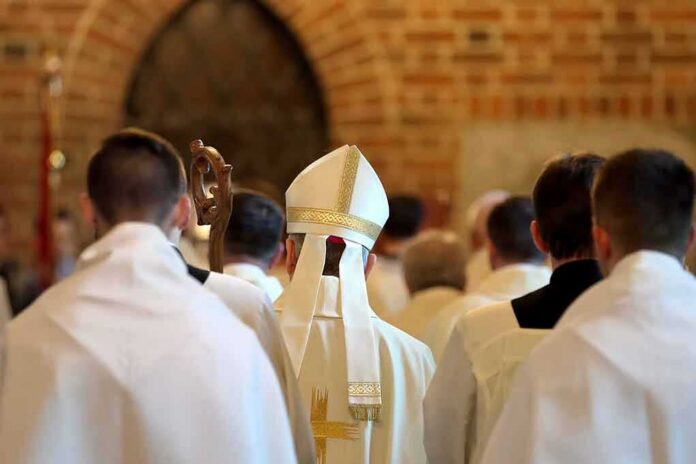
Archbishop Jean-Abdo Arbach, a Melkite Greek Catholic leader in Homs, confirmed by phone that several men burst into his office on November 14. He said the men tied him up, gagged him, ransacked the room, and stole personal items, including a Marian image. Reports from church outlets repeated the timeline and details, noting that the assault left the 74-year-old shaken but alive. These accounts describe a targeted, invasive crime against a senior Christian figure at his place of ministry.
Patriarchs and heads of churches in Syria publicly condemned the attack soon after it became known. Their statement called the assault part of a string of offenses, alongside kidnappings and threats, aimed at Christian communities. The leaders warned that authorities have failed to stop the violence and demanded real protection, not vague promises. The coalition included the Greek Orthodox, Syriac Orthodox, and Melkite Greek Catholic patriarchs, signaling rare unity across ancient traditions.
Why church leaders call it a pattern
Church leaders did more than condemn a single incident. They linked the assault to repeated attacks that spread fear, shrink congregations, and erode trust in civil order. Their warning echoes field reports that Christians face special risks in mixed or contested areas. They point to recent kidnappings and intimidation that force families to move or to hide faith symbols in public. Their core claim is simple: lack of security lets criminals and extremists prey on a small, aging flock.
That claim aligns with years of evidence from researchers and human rights monitors. Since the war began, extremist groups like the Islamic State and al-Nusra Front targeted Christians with forced displacement, confiscation, and killings, while the broader conflict damaged churches and neighborhoods. The United States Department of State has also tracked discrimination and attacks, and it notes a sharp fall in the Christian share of Syria’s population, with some estimates near the low single digits.
The cost of fear for a shrinking minority
Demographics tell the story few want to read. Scholars and aid agencies estimate that Christians, once about six to ten percent of Syria, now make up a much smaller slice due to flight, low returns, and aging communities. One survey of conflict impacts counted dozens of destroyed churches since 2011, with hundreds of thousands of believers leaving homes, jobs, and parishes behind. Families who stay weigh daily risks: send kids to school, open a shop, or keep the cross on the gate and hope it stands another week.
In mid-November 2026, senior Syrian church leaders (Greek Orthodox, Syriac Orthodox, and Melkite Greek Catholic patriarchs) issued a joint statement condemning a series of attacks on Christians, including the binding, blindfolding, and assault of Archbishop Youhanna Abdo Arbash…
— jcope (@jtcope4) November 19, 2026
The Homs assault sharpens a policy question that should be easy but often is not: Will local authorities guarantee equal safety for Christians as citizens, not as clients? Church leaders say the answer so far is no, and their public call puts the duty on officials to act, not talk. Common sense and conservative values align here. Order, property rights, and free worship are non-negotiable. A state that cannot shield a bishop in his office invites lawlessness everywhere.
What to watch next
Investigators must identify the assailants and motives and restore confidence with arrests and public charges. Church leaders will keep pressing for patrols, checkpoints, and rapid response around churches, schools, and clergy residences. Aid groups will watch for copycat crimes and displacement spikes. The measure of progress will be simple: Sunday liturgies without fear, priests walking home without escorts, and bishops whose doors stay open to the flock without a lock and chain.
Sources:
lifesitenews.com, en.acn-global.org, infovaticana.com, csi-int.org, orthodoxtimes.com, vaticanreport.com, kurdistan24.net, albawaba.com, damascusinstitute.org, digitalcommons.csbsju.edu, academic.oup.com, timesofisrael.com
© ournationnews.com 2026. All rights reserved.