
No explosives were found after a wave of bomb threats forced European flights to divert, land, and face full security sweeps.
Story Snapshot
- Four flights in Europe faced bomb threats; all searches found no explosives.
- A Heathrow–Warsaw flight diverted to Warsaw-Modlin; the airport briefly closed.
- A Copenhagen–Warsaw flight landed at Chopin Airport and was cleared.
- A Manchester–Murcia Ryanair flight and an Israel–Sofia flight were inspected and cleared.
What Happened Across European Skies
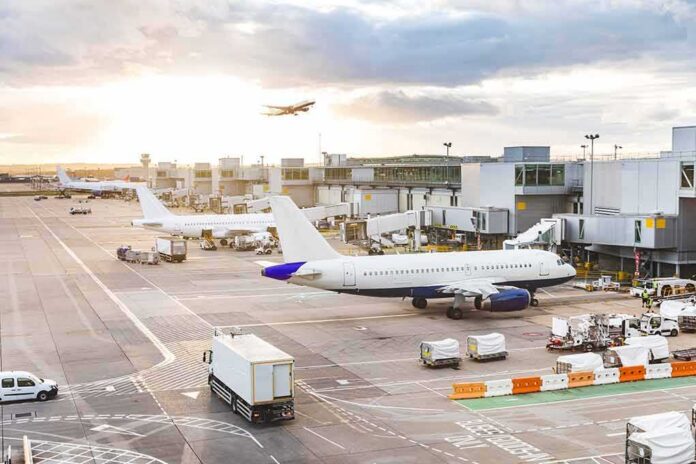
European aviation authorities handled several bomb threats on Tuesday, and every aircraft landed safely. A London Heathrow–Warsaw flight diverted to Warsaw-Modlin after a reported device alert. Authorities closed the airport for checks, then reopened it after clearing the aircraft and area. A Scandinavian Airlines flight from Copenhagen landed at Warsaw Chopin and underwent a search that found no explosive device. A Ryanair flight from Manchester to Murcia landed in Spain, where police examined the aircraft and found no explosives.
Another flight from Israel to Sofia landed without incident after the operator received an email threat. Bulgarian authorities searched the aircraft and reported no device on board. A related case the previous day involved a Wizz Air jet from London Luton to Sofia that diverted to Budapest after a bomb threat. A Hungarian Air Force fighter escorted it; security teams cleared the aircraft and found nothing during searches on the ground. These responses followed standard aviation protocols designed to treat every threat as credible until checked.
How Authorities Responded, Step by Step
Air traffic control routed affected aircraft to airports with the staff and space for security screening. Police and bomb-disposal teams met planes on arrival. Passengers waited off the aircraft while teams conducted searches with canines and equipment. Warsaw-Modlin paused operations to keep runways and aprons clear for responders. Airlines coordinated with security services to secure luggage, inspect cabins, and verify cargo. Wizz Air and airport officials stated that checks on the diverted flights did not find explosive materials.
Reporters and airport spokespeople gave passenger counts and aircraft details that vary slightly by outlet, which often happens during live incidents. The core outcomes match across sources: safe landings, inspections, and no explosives recovered. Officials did not announce suspects or motives in the immediate aftermath. Media accounts and brief comments captured the essentials while deeper investigative records remained with national authorities.
Why Hoax Threats Still Cause Real-World Disruption
Airlines and airports must act on threat messages because one miss could be tragic. That is not fear; it is common sense. Layers of security stop many risks before boarding, but threat calls and emails still force a reset. Trained crews divert. Police search. Schedules break. The public sees flashing lights and delayed flights, then later reads that no bomb was found. The gap between what people see and what happened can drive confusion, but the safety-first response is the only responsible playbook.
✈️ ⚠️ 🇪🇺 At least four European flights were targeted by bomb threats on Tuesday, forcing the temporary closure of one Warsaw airport, but all planes landed safely and no explosives were found, authorities said ➡️ https://t.co/xW6dzSthTW pic.twitter.com/29Pq5dWv7U
— AFP News Agency (@AFP) November 3, 2026
History shows this pattern repeats. Threats often prove false, yet they drain time, fuel, and public trust. Analysts note that security layers reduce the chance of a successful attack, but they cannot stop a bad email from triggering a response on the ground. That is why threat-makers, even hoaxers, can cause outsized disruption for a tiny cost. Conservative instincts favor deterrence and consequence here: stiff penalties for false threats, stronger digital tracing, and fast public updates once aircraft are cleared.
What Matters Now for Travelers and Operators
Travelers should expect that any mid-air threat will trigger diversions and long waits. Crews train to handle this calmly, and they did so here. Airports that can absorb diverted flights and host security teams reduce risk for everyone else in the air. Airlines should share clear, plain-language updates once police finish checks. That helps cut rumors while respecting ongoing investigations. The balance is simple: protect lives first, then restore normal traffic and inform the public without drama.
Authorities across Europe will review logs, track the origin of messages, and compare timelines. If cases link, a joint inquiry with Europol or national cyber units could follow. If not, each country will close its file once leads end. Either way, the metrics to watch are the same: time to diversion, time to clearance, number of passengers affected, and whether investigators identify a sender. On Tuesday’s flights, the single key fact stands: all threats were checked, and no explosives were found.
Sources:
insiderpaper.com, bbc.co.uk, bssnews.net, nbcnews.com
© ournationnews.com 2026. All rights reserved.