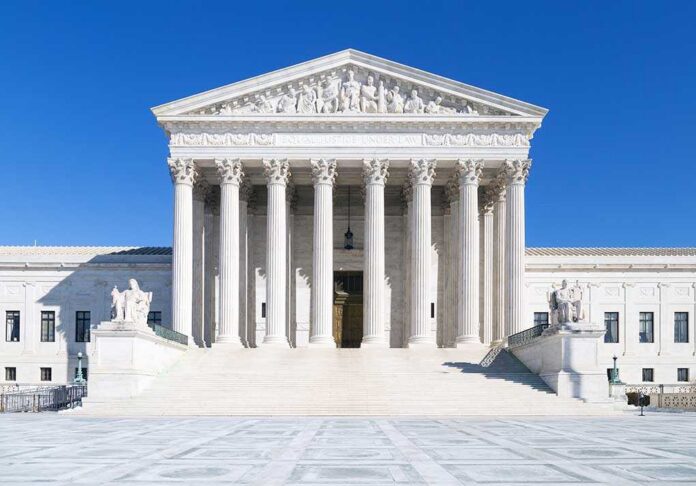
The Supreme Court just handed Republicans the keys to potentially 27 additional House seats and a generation of unassailable congressional control through a single ruling that fundamentally rewrites how America draws its electoral maps.
Story Snapshot
- Supreme Court ruling limits Voting Rights Act Section 2, enabling Republican map redrawing across Southern states
- Analysis projects Republicans could gain 19-27 safe House seats through combined racial and partisan gerrymandering mechanisms
- Up to 30% of Congressional Black Caucus members could lose seats as minority voting power faces systematic dilution
- Nine Southern states positioned to eliminate Democratic representation or dramatically reduce delegation sizes before 2026 midterms
The Judicial Earthquake That Reshapes Congressional Power
The Supreme Court voted 6-3 along ideological lines to restrict how the Voting Rights Act of 1965 creates majority-minority districts. The decision rejected Louisiana’s congressional map containing a second majority-Black district, establishing precedent that reverberates across every state with significant minority populations. Justice Samuel Alito’s reasoning connected the 2019 Rucho v. Common Cause decision—which declared partisan gerrymandering beyond judicial review—to racial redistricting requirements. This creates a perverse constitutional framework: states can now argue maps drawn for raw partisan advantage satisfy civil rights law, effectively immunizing political power grabs behind claims of partisan motivation rather than racial discrimination.
The Mathematics of Political Domination
Fair Fight Action and Black Voters Matter Fund quantified the electoral carnage this ruling enables. Republicans gain 19 safe House seats directly from weakening Section 2 of the Voting Rights Act. Combine that with eight additional seats from other mid-decade redistricting maneuvers, and the total reaches 27 new Republican strongholds. These aren’t competitive districts that might flip in wave elections—these are safe seats designed to withstand any political headwind. The current House operates on razor-thin margins where five seats determine majority control. A 27-seat structural advantage transforms American democracy from competitive elections into predetermined outcomes regardless of voter preferences or national sentiment.
Texas exemplifies the redistricting alchemy at work. Fair maps would yield 18 Democratic seats based on population and voting patterns. Current maps deliver just 13. Florida tells an even starker story, shifting from a 16-11 Republican edge to 20-8 with zero competitive races remaining. The Brennan Center documented how Republican gerrymandering in Southern and Midwestern strongholds already created a 16-seat structural advantage in 2024 maps before this Supreme Court decision opened floodgates for additional manipulation.
Nine States Where Democratic Representation Faces Extinction
Alabama, South Carolina, Tennessee, and Mississippi stand poised to eliminate every Democratic House member through post-ruling redistricting. Louisiana, Georgia, North Carolina, Texas, and Florida would retain token Democratic representation but face dramatic delegation reductions. These nine states share common characteristics: significant minority populations that currently enable some Democratic victories, Republican-controlled state legislatures with unfettered map-drawing authority, and no state constitutional constraints on partisan gerrymandering. The ruling provides legal cover for what would have constituted clear Voting Rights Act violations just months ago.
The Congressional Black Caucus faces an existential threat with 30% of members potentially losing seats. The Congressional Hispanic Caucus confronts 11% losses. These aren’t abstract percentages—they represent the systematic dismantling of minority political representation achieved through decades of civil rights litigation and advocacy. LaTosha Brown of Black Voters Matter Fund characterized the ruling as clearing “the path for a one-party system where power serves the powerful and silences the people,” a assessment the numerical analysis supports.
The Constitutional Paradox Enabling Partisan Capture
The Supreme Court created a constitutional catch-22 that privileges partisan power over civil rights protections. The 2019 Rucho decision declared federal courts lack authority to review partisan gerrymandering, classifying it as a political question beyond judicial reach. This new ruling allows states to invoke partisan intent as justification for maps that devastate minority voting power. The logic becomes circular and self-reinforcing: courts cannot review partisan gerrymandering, therefore maps drawn for partisan purposes escape scrutiny even when they systematically dilute minority representation that the Voting Rights Act exists to protect.
Chief Justice John Roberts and Justice Brett Kavanaugh previously upheld Section 2 in a similar case two years prior, making their apparent shift particularly consequential. The six Republican-appointed justices seem divided only on technical implementation questions, not whether to weaken Section 2 protections. This consensus signals the outcome’s inevitability regardless of legal arguments presented. Election lawyers across the political spectrum expect sweeping changes to Southern congressional delegations, with states that gained seats in the 2020 census facing particular vulnerability to aggressive redistricting.
Timing and Implementation Mechanics
The ruling’s proximity to the 2026 midterms creates urgent questions about implementation timelines. While redistricting before next year’s elections seems unlikely, voting rights organizations acknowledge it remains possible. States could move quickly to redraw maps once the formal decision issues, compressing normally lengthy redistricting processes into months. Even if implementation delays until the 2028 cycle, the structural advantage persists for the remainder of the decade and beyond, cementing Republican House control regardless of national political sentiment or demographic changes that typically favor Democrats.
The Broader Civil Rights Implications
A ruling establishing that race can never be considered—even to remedy discrimination—extends far beyond congressional redistricting. Housing policy, education access, and employment discrimination cases rely on similar legal frameworks that permit race-conscious remedies for documented civil rights violations. The Supreme Court’s reasoning could metastasize across these domains, dismantling the legal architecture that transformed America from Jim Crow apartheid to a society where civil rights laws carry enforcement mechanisms. Communities of color nationwide face voting power dilution echoing pre-1965 conditions when legal barriers systematically excluded minority political participation.
The Democratic Party acknowledges theoretical opportunities to exploit Voting Rights Act changes in heavily-blue areas, but recognizes these pale compared to Republican advantages in Southern and Midwestern strongholds. Geography and demography create asymmetric gerrymandering potential. Democratic voters concentrate in urban centers, making it difficult to spread them across multiple districts without creating obvious partisan gerrymanders. Republican voters distribute more evenly across suburban and rural areas, enabling sophisticated map-drawing that appears facially neutral while delivering overwhelming partisan advantages. This geographic reality means weakening the Voting Rights Act primarily benefits Republicans regardless of which party controls specific state legislatures.
Sources:
Republicans Could Gain Dozens of House Seats After SCOTUS VRA Ruling – Politico
How Gerrymandering Tilts the 2024 Race for the House – Brennan Center for Justice
Rucho v. Common Cause – Wikipedia













![🇺🇸 First Lady Melania Trump Unveils New Fostering the Future & IndyCar Scholarships [LIVE]](https://ournationnews.com/wp-content/uploads/sites/26/2026/08/maxresdefault-43-100x70.jpg "Melania Speaks Out Amid Trump Aide Rumors")