

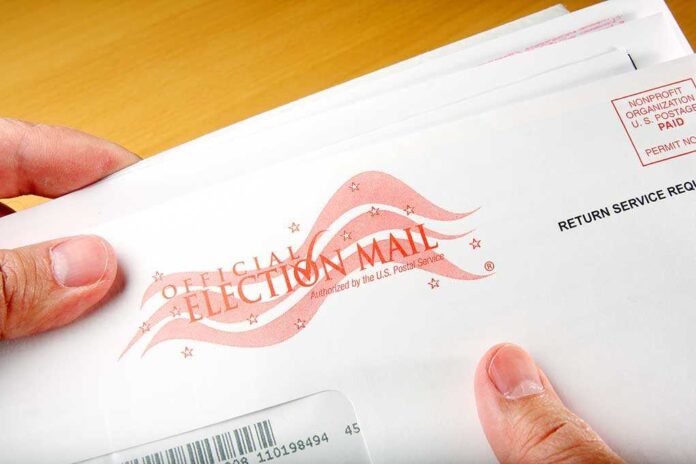
A Supreme Court case threatens to alter mail-in voting laws, potentially disenfranchising countless voters, raising concerns among conservatives about election integrity and federal overreach.
Story Highlights
- The Supreme Court will decide if mail-in ballots postmarked by Election Day but received later can be counted.
- Mississippi’s law, allowing ballots to arrive five days post-election, is under scrutiny.
- Ruling could impact 16 states and D.C., affecting millions of voters.
- Conservatives argue this case is pivotal for maintaining election integrity.
Supreme Court to Decide on Mail-In Ballot Grace Periods
The U.S. Supreme Court is set to hear a landmark case, Watson v. RNC, that challenges Mississippi’s law allowing mail-in ballots to be counted if received within five days post-Election Day. This case has national implications, as it could impact similar laws in 16 states and Washington, D.C. The Republican National Committee (RNC) argues these laws conflict with federal election law, which mandates a single Election Day.
This decision could set a significant precedent, potentially affecting millions of voters, including military, disabled, and absentee voters who rely on mail-in ballots. The case highlights the ongoing tension between state election flexibility and the need for federal uniformity in election laws. Conservatives view this as a critical moment to uphold election integrity and prevent potential disenfranchisement due to mail delays.
Potential National Impact of the Ruling
If the Supreme Court rules against the grace periods, affected states may be forced to amend their election laws. This could lead to significant changes in how mail-in ballots are handled, potentially disenfranchising voters who mail their ballots on time but fall victim to postal delays. The decision is crucial for upcoming elections, where mail-in voting is expected to play a significant role.
Beyond the immediate implications for voters, the ruling could intensify debates over election integrity and voter access. Conservatives argue that strict adherence to Election Day deadlines is essential to ensure timely and uniform election results. However, proponents of grace periods emphasize their importance in safeguarding voter access, particularly for military and overseas voters who may face unique challenges in returning their ballots on time.
Stakeholders and Their Interests
The primary stakeholders in this case include the RNC, which is pushing for uniformity and strict election deadlines, and the state of Mississippi, defending its law as a measure to protect voter access. The Department of Justice has historically supported extending deadlines for military voters, emphasizing the need to ensure all eligible votes are counted. Voters themselves, especially those relying on mail-in ballots, stand to be directly affected by the outcome of this case.
As the Supreme Court prepares to hear this case, the nation watches closely, aware of its potential to reshape mail-in voting rules and influence future elections. The decision will undoubtedly have far-reaching consequences for election administration, voter participation, and the broader legal landscape surrounding mail-in ballots.
Sources:
U.S. Supreme Court to Hear Critical Case on Mail Ballot Deadlines