Hundreds of pounds of fireworks turned a quiet Whidbey Island home into a blast zone, and the most important question is not what exploded, but why it was there at all.
Story Snapshot
- Officials said about 700 pounds of fireworks were stored inside the house.
- The blast destroyed two homes, damaged a third, and injured five people.
- Fire officials said smoking materials may have sparked the explosion, but the case remains open.
- No arrests had been made when the reports were filed.
The Explosion That Split a Neighborhood
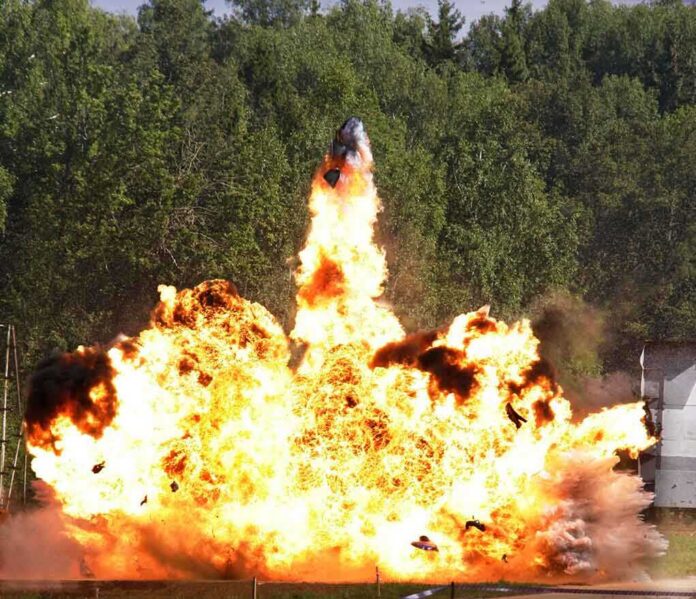
The explosion hit Whidbey Island with the kind of force that changes a neighborhood in seconds. Fire officials said the blast destroyed two homes, damaged a third, and scattered debris across the area. Five people were hurt, including three firefighters. One firefighter needed surgery for a hand injury. The scene was severe enough that neighbors later described it as a string of blasts that kept going long after the first fireball.
Officials said the home held roughly 700 pounds of fireworks, enough to fill a pallet. That detail matters because it turns a house fire into a storage failure. Fire Chief Jerry Helm said investigators believed the fireworks were stored inside the residence, and early reports pointed to smoking materials nearby as the possible trigger. He described the stash as a “ticking time bomb,” which is blunt language, but the footage and damage make that warning hard to dismiss.[1][2]
What Investigators Think Happened
The leading theory is simple, and that is what makes it unsettling. Fire officials said someone may have been smoking near the fireworks, and an ash or other smoking material may have started the chain reaction. That is still a preliminary finding, not a final legal conclusion. No arrests had been made, and the county sheriff said the incident remained under active investigation. In other words, the fire chief’s account is serious, but it is not the same thing as a completed forensic ruling.[1][2]
That gap matters because people often confuse a strong suspicion with proof. The reports say investigators “believe” smoking sparked the blast. They do not say anyone saw the exact moment of ignition. They do not say the cause has been proven in court. For readers who care about plain facts, that distinction is the whole story. The fireworks were there. The explosion was real. The exact spark still sits inside the open part of the investigation.[2][3]
Why the Fireworks Were There at All
One of the strangest parts of the case is the storage itself. Neighbors said they had seen crates of fireworks delivered to the home, and they had complained before about backyard burning. Reporters also said the fireworks were tied to an order for an event on the nearby peninsula. That leaves an obvious question: why was such a large amount stored in a residence at all? The reports do not answer that, and that silence keeps the story from being neatly wrapped up.[2][7]
A massive fireworks explosion destroyed multiple homes on Whidbey Island on Tuesday afternoon, leaving families homeless and triggering a federal investigation. https://t.co/2nucci8UsK
— FOX 13 Seattle (@fox13seattle) June 26, 2026
This is where the case becomes bigger than one house and one bad night. The blast shows how a single act of careless storage can put first responders in danger before they even reach the door. It also shows how quickly a neighborhood can be swallowed by a problem that should never have been inside a home in the first place. Fireworks are not harmless decorations when they are stacked in bulk next to living space and an open flame source.[1][4]
What Makes the Story Hard to Ignore
The public often hears a story like this and settles on the simplest answer. In this case, that answer is smoking near fireworks. But the sharper lesson is about risk. A home does not need a warehouse label to become a bomb. It only needs the wrong materials, the wrong storage, and one small ignition source. That is why officials spoke so urgently after the blast. The margin between a scare and a mass-casualty event can be only a second or two.[4]
The Whidbey Island case also shows how fast a local disaster becomes a public narrative. Once a fire chief gives a likely cause, headlines harden around it. That can be useful when the facts are strong. It can also flatten the uncertainty that belongs in an active investigation. Here, the strongest verified facts are the destruction, the injuries, and the huge fireworks cache. The weakest point is the exact ignition source. That is still being worked through by investigators.[1][2][4]
Sources:
[1] Web – Hundreds of pounds of fireworks explode, destroying homes and injuring …
[2] Web – Whidbey Island, WA fireworks blast destroys homes, injures 5
[3] Web – ATF report IDs ‘blast seats’ in fatal explosion – Whidbey News-Times
[4] YouTube – 700lbs of fireworks destroys 2 Whidbey homes
[7] Web – A massive explosion triggered by hundreds of pounds of stored …
© ournationnews.com 2026. All rights reserved.




![🇺🇸 First Lady Melania Trump Unveils New Fostering the Future & IndyCar Scholarships [LIVE]](https://ournationnews.com/wp-content/uploads/sites/26/2026/08/maxresdefault-43-218x150.jpg "Melania Speaks Out Amid Trump Aide Rumors")










![🇺🇸 First Lady Melania Trump Unveils New Fostering the Future & IndyCar Scholarships [LIVE]](https://ournationnews.com/wp-content/uploads/sites/26/2026/08/maxresdefault-43-324x160.jpg "Melania Speaks Out Amid Trump Aide Rumors")