

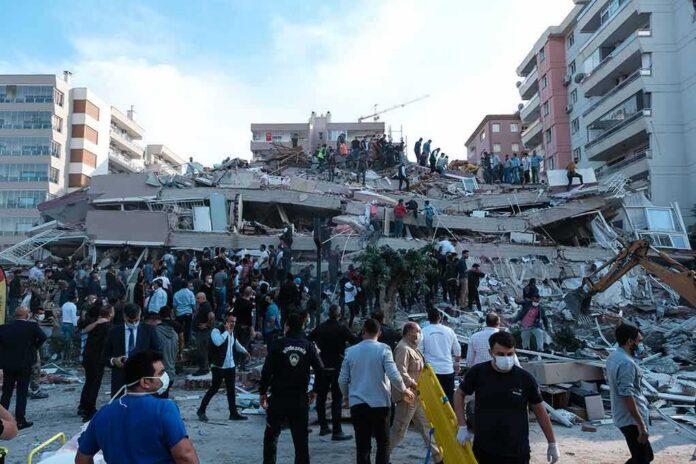
Satellite data turned Venezuela’s earthquake damage into a number so large it is hard to picture: more than 58,000 buildings likely hit, with the final human cost still rising.
Story Snapshot
- NASA-linked satellite analysis found roughly 58,870 buildings were likely damaged or destroyed after the twin quakes.[1]
- Officials and news reports said the death toll had already reached about 1,700, with thousands still missing.[1]
- The damage assessment was rapid and preliminary, not a ground inspection, so the figure is a warning sign, not a final audit.[1]
- The quake response is unfolding against the backdrop of Venezuela’s long crisis, weak services, and deep mistrust of official numbers.[4][8]
A Damage Count That Reshapes the Scale of the Disaster
The most important detail is not just the size of the number. It is what the number suggests about the reach of the disaster. Researchers Corey Scher and Jamon Van Den Hoek said satellite radar data from June 25 indicated approximately 58,870 buildings were likely damaged or destroyed across the affected region. They also stressed that this was a preliminary rapid assessment, based on abrupt surface change consistent with damage, and not a ground-verified count.[1]
That matters because earthquake chaos often hides the full picture for days or weeks. In this case, the satellite view gives outside observers an early map of where the hardest hits may have landed. It does not tell the whole story about structural safety, rescue access, or how many people were inside those buildings when the ground moved. It does, however, signal a disaster large enough to overwhelm normal response systems.
Why The Human Toll May Still Climb
The reported death toll was already about 1,700, with thousands still missing, according to the report citing official and published figures. Bloomberg’s Andreina Itriago said the government’s casualty count is likely underreported and that more deaths are expected as rescue work continues. Reuters also reported that foreign crews and aid only began reaching devastated areas nearly two days after the quakes.[1][5]
Those details point to the same basic problem. The first days after a major quake decide who lives and who does not. When roads break, buildings collapse, and communications fail, speed becomes everything. Even a well-run response can struggle. In Venezuela, critics say the state’s response was slower and weaker than it should have been, while officials and allied reports say the country was dealing with an extreme crisis under severe constraints.[3][11][13]
The Fight Over Responsibility Is Also A Fight Over Trust
AP News reported that Venezuela’s tight control over news media has long raised questions about the accuracy of official figures. That does not prove any single number is wrong. It does explain why outside observers treat official counts with caution. In a disaster this large, trust becomes part of the rescue operation. If people doubt the numbers, they also doubt the pace, the priorities, and the promises.[2]
5/14 🇧🇷 S.AMERICA — Venezuela's death toll from last week's twin earthquakes has risen above 1,700, with roughly 50,000 people still listed as missing as efforts in La Guaira shift from rescue to recovery. The magnitude 7.2 and 7.5 quakes struck near Caracas, collapsing hundreds…
— The Syndicate (@SyndicateRSS) June 30, 2026
The political backdrop matters too. World Vision described Venezuela as already living through a prolonged humanitarian crisis marked by economic pain, strained services, and mass displacement before the quakes hit. That context helps explain why a new disaster could do so much damage so fast. A country with weaker housing, thinner services, and fewer reserves has less room to absorb a sudden shock. The quake did not create those weaknesses, but it exposed them at once.[4]
What The Satellite Image Can And Cannot Prove
The satellite estimate is powerful because it captures broad damage faster than field teams can. It also has limits. It cannot say which damaged buildings were homes, apartments, schools, or offices. It cannot tell whether some structures were already weak before the quake. It also cannot replace engineering inspections or casualty verification. The report itself warned readers to treat the count as an indicator, not a final judgment.[1]
Still, the image of 58,000-plus damaged buildings changes the conversation. This is no longer a story about one broken neighborhood or a single collapsed block. It is a regional disaster with enough force to strain hospitals, rescue crews, transport, and public trust at the same time. That is why every new count, every missing person, and every delayed convoy matters. The next hard question is not whether the damage was severe. It is whether anyone can yet measure how severe it truly was.
Sources:
[1] Web – Here’s What’s Holding Up Venezuelan Earthquake Recovery Efforts
[2] YouTube – Venezuela Struggles with Earthquake Rescue Efforts as Death Toll …
[3] Web – Venezuela earthquake death toll passes 1700 | AP News
[4] Web – How Venezuela’s earthquakes test U.S.-backed government – NPR
[5] Web – For Venezuelans, these first 72 hours after the earthquakes have …
[8] Web – Venezuelans are struggling to cope with the aftermath of … – …
[11] Web – Trump Administration Mobilizes Robust Response to Tragic …
[13] Web – Statement on U.S. military support to Venezuela earthquake relief
© ournationnews.com 2026. All rights reserved.