

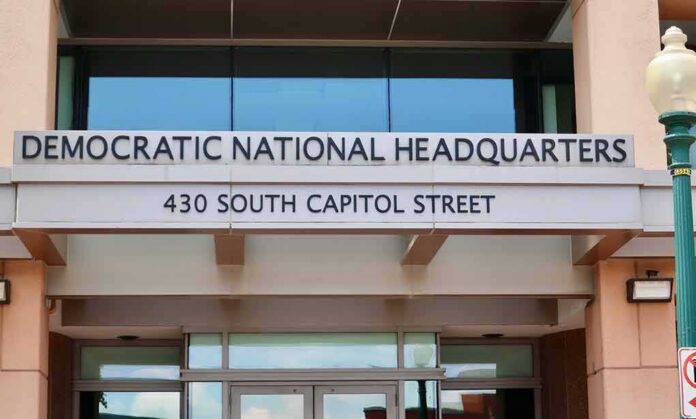
The national party that wants to run America’s economy just had to mortgage its own headquarters to keep the lights on.
Story Snapshot
- The Democratic National Committee pledged its Washington, D.C. headquarters to secure a $15 million credit line.
- Federal records show the committee heading into the 2026 midterms with more debt than cash on hand.
- Republicans enjoy a huge money edge, with tens of millions in cash and no debt, while Democrats juggle loans and interest payments.
- Party insiders insist this kind of borrowing is routine, but the numbers and timing tell a much darker story.
The headquarters-for-cash deal that set off alarm bells
The Democratic National Committee used its brick-and-mortar headquarters at 430 South Capitol Street Southeast in Washington as collateral to obtain a $15 million line of credit in 2025. Reporters uncovered District of Columbia deed records showing the building pledged to the lender to support off-year election spending and party operations. The committee did not hype this move in public; it only became widely discussed after that deed surfaced and outside outlets began framing the step as a sign of distress.
BROKE Democrats Put Up DNC Headquarters as COLLATERAL for Massive $15 Million Loan Ahead of 2026 Midterms
— 🇺🇸🇨🇿🇸🇪 PENNSYLVANIA IS TRUMP™ (@RED_IN_PA) July 27, 2026
The credit line plugged an immediate hole. The New York Times reported that in October 2025 the Democratic National Committee took out a $15 million loan to restore diminished reserves and fully fund Virginia and New Jersey races while preparing for 2026. After the borrowing, the committee reported about $18.3 million available, showing how central the loan was to its cash position. Without that facility, the fund would have been far thinner heading into a high-stakes midterm cycle.
The numbers behind the “broke Democrats” narrative
Federal Election Commission records and major outlets agree on one core fact: the Democratic National Committee has more debt than cash going into the 2026 midterms. June filings showed roughly $16.3 million in cash and $18.5 million in debt, leaving liabilities about $2.2 million above reserves. Earlier reporting described the party starting 2026 with about $14 million in assets against $17.5 million owed. That is not formal bankruptcy, but it is a negative balance sheet for a national party that must fund races nationwide.
The contrast with Republicans is brutal. The Republican National Committee reported roughly $128 million in cash and no debt, giving President Trump’s party a massive war chest while Democrats lean on borrowed money. Conservative critics have seized on this gap, arguing that a party that cannot manage its own books should not be trusted with the federal budget. From a common-sense standpoint, it is hard to ignore a seven-to-one cash advantage when judging which side is better prepared to compete.
How the DNC explains mortgaging its building
Democratic National Committee officials push back on the “broke” label. A party representative told NOTUS that using the headquarters as collateral “is not new” and said the building had backed prior credit lines in 2014, 2018, 2019, and other years. The message is simple: this is routine election-cycle finance, not a fire sale. They frame the 2025 deal as a standard tool to smooth cash flow between donations and big spending spikes in key contests.
That defense has some merit. Politico reported that the committee has taken loans before, but usually not this early in the cycle or at this size. Past midterm periods also saw the party carry debt to keep operations moving. According to this view, borrowing against an owned building is just smart use of assets. For readers who value basic business sense, the question becomes whether this is normal leverage or warning-sign leverage. The timing, size, and current strain suggest this is closer to a red flag than a routine adjustment.
Debt, interest, and what it means for 2026 strategy
Loans are not free money. Outlets sympathetic to Republican concerns point out that the Democratic National Committee owes heavy interest and principal payments on that $15 million credit line. One analysis estimated the committee has already paid over $700,000 in interest, with monthly interest bills over $75,000 and scheduled principal payments of roughly $1.66 million starting in January. Those are dollars that cannot go to candidates, ground operations, or advertising in swing districts.
The Washington Post reported that ongoing financial troubles forced the Democratic National Committee to scale back some plans, with $17.4 million in debt and only $15.9 million in reserves by February. Fox News highlighted that the committee entered the final 100 days before the midterms with no room to send its usual transfers to key congressional campaign arms. From a practical standpoint, that means fewer resources flowing to vulnerable Democratic incumbents and challengers, while Republicans can deploy cash freely.
Is this a one-off crisis or a deeper pattern?
The deeper story is a long-running weakness. The New York Times noted that the Democratic National Committee started 2025 with $22 million on hand while the Republican National Committee had $38 million, and that the gap has since grown to nearly $100 million. The party has also been cleaning up after Kamala Harris’s failed 2024 campaign, paying off tens of millions in leftover expenses. That hangover combined with sluggish new fundraising has pushed the committee toward heavier borrowing and more aggressive collateral use than in past cycles.
Party borrowing itself is not unusual, but using the headquarters to support a historically large off-year loan while debt exceeds cash is stark. For conservatives, this picture supports a familiar argument: progressive leadership spends first and worries about the bill later. The facts show a committee that can still operate, but only by mortgaging its core asset and handing future donations to the bank before they reach candidates. Whether voters connect those dots in 2026 may matter almost as much as any single campaign message.
Sources:
thegatewaypundit.com, townhall.com, redstate.com, youtube.com, nytimes.com, cnn.com, washingtonpost.com
© ournationnews.com 2026. All rights reserved.