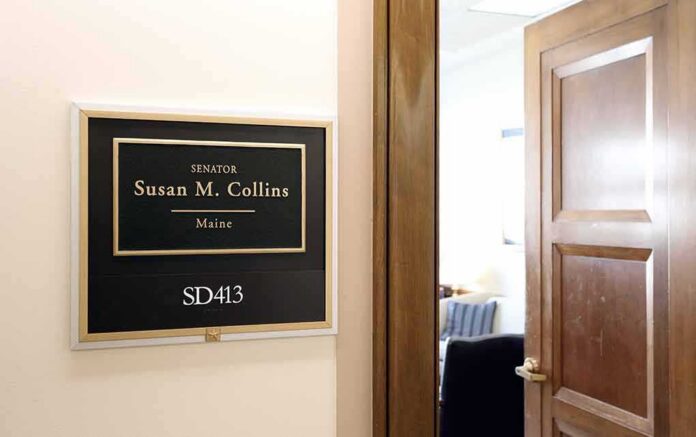
Troy Jackson turned a Senate debate into a referendum on Susan Collins and Donald Trump, then watched the math he relied on start to wobble.
Story Snapshot
- Jackson hammered Collins with a “96% with Trump” claim that Collins disputed as cherry-picked.
- Collins said she fought Trump’s Canada tariffs and got key Maine goods removed from the list.
- Abortion dominated as Jackson tied Collins’ 2018 Kavanaugh vote to Roe’s fall.
- Healthcare funding fights turned on a complex bill Collins advanced, then opposed on final passage.
Jackson’s One-Number Strategy Meets a Denominator Problem
Jackson said Collins votes with Trump 96% of the time and repeated it so often it became his brand for the night. Collins countered that the number came from a study that only counted a subset of votes and ignored many others. Broader analyses put her alignment far lower. The clash showed why single-number claims can mislead. Many studies change when the denominator changes. Collins pressed that point and forced Jackson to defend his math.
The conservative read here is simple: if your case rests on a shaky metric, your case is shaky. Voters deserve full ledgers, not bumper stickers. Jackson’s repetition might rally partisans, but it fails the common-sense test. If you claim 96%, you should show every vote you counted and why you counted it. Collins smartly shifted the ground to method, which is where many campaign “scores” go to die.
Tariffs: Local Stakes, Limited Proof of Broad Backing
Jackson tried to staple Collins to Trump’s tariffs. Collins said she opposed tariffs on Canada from the start and called herself their most outspoken critic. She said she got concrete, pulp, and road salt off the list. Those inputs matter to Maine’s roads and mills. That record undercuts any claim that she backed the tariff regime in full. Jackson can argue she should have fought harder, but that is a judgment call, not a clean factual hit.
Voters who care about kitchen-table costs should focus on tangible wins. Removing road salt and pulp from tariffs is tangible. It helps towns keep roads safe and mills keep people working. From a right-leaning, results-first lens, this is governance over grandstanding. If Collins fought a Republican president’s tariffs when they hurt Maine and won exceptions, that reads like independence, not blind loyalty.
Abortion Flashpoint: The Kavanaugh Vote Revisited
Jackson opened with abortion and tied Collins to Brett Kavanaugh’s 2018 confirmation. Kavanaugh later joined the majority that ended Roe v. Wade. Collins defended her vote as based on qualifications and assurances that Roe was “settled law.” She said she does not believe he lied but that he should not have used that phrase. Jackson pushed her to admit error. She did not. This part of the debate sharpened the moral stakes without adding new facts.
For pro-life conservatives, Kavanaugh’s jurisprudence is a feature, not a bug. For voters who separate process from outcomes, Collins’ stance follows a standard Senate frame: judge nominees on record and statements, not on guesses about future cases. Jackson’s argument stirs passion, but it hangs on hindsight. The vote is public and settled; motives are harder to prove. That leaves values, not evidence, deciding this line of attack.
Healthcare: A Bill, An Offset, And A Price Tag
Jackson accused Collins of enabling a bill that cut healthcare to reward the wealthy. Collins said she let the package advance to secure a $50 billion rural healthcare fund, then voted against final passage because of Medicaid cuts. That sequence is messy, but it is also normal Senate trench work. The charge that she “voted for cuts” glosses over the advance-then-oppose tactic she described on stage.
UPDATE: Susan Collins and Troy Jackson clash over Trump and seniority in Maine’s first Senate debate https://t.co/4YHXe3fKGJ
Confidence 89/100 · Divergence 62/100
— Highwire (@HighwireNews) October 7, 2026
Results matter most. Rural hospitals either get funding or they do not. Collins says she delivered money and voted no on the final bill when she could not fix the cuts. Jackson says the process still raised costs and hurt care. The truth likely lives in the details of what Maine hospitals received, when they received it, and what closed anyway. Until those ledgers are laid out, broad claims about blame read more like slogans than proof.
What The Debate Actually Settled
The debate proved that Jackson wants the race to be about Trump first, last, and always. Collins wants it to be about her record, her chairmanship, and checks she brought home. The 96% number gave Jackson a sharp spear, but Collins showed the wood grain on the shaft. On tariffs, her Maine-first exceptions spoke louder than his general claim. On abortion, voters will sort principle from process on their own. On healthcare, both sides owe receipts.
Sources:
pjmedia.com, us.headtopics.com, newsbreak.com
© ournationnews.com 2026. All rights reserved.