
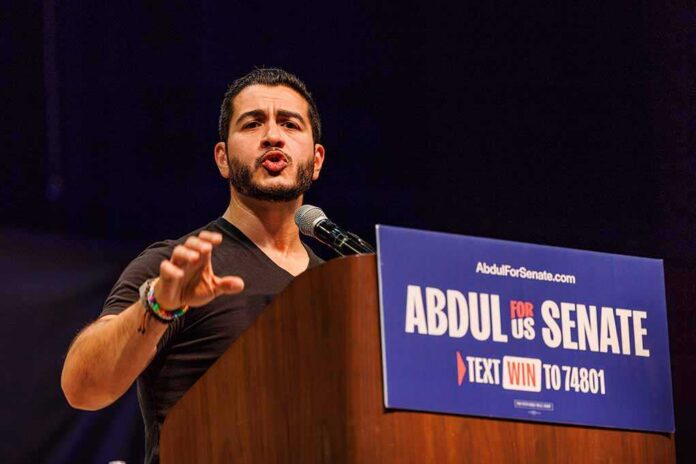
A smiling photo and a single sentence about “ethnostates” just kicked open a fight over principle versus tribe.
Story Snapshot
- Abdul El-Sayed appeared alongside Pakistan’s former president Arif Alvi and later received Alvi’s public congratulations after winning his Senate race.
- El-Sayed said he opposes ethnostates and framed his stance as equal rights for Palestinians and Jewish Israelis.
- Alvi’s post tied El-Sayed’s win to Gaza and to rejecting hatred and injustice.
- Pakistan’s blasphemy laws carry harsh penalties and fuel mob violence, drawing years of rights-group alarms.
The flashpoint: a photo, a quote, and a charge of hypocrisy
RedState and allied outlets led the hit, arguing El-Sayed blasted Israel’s Jewish identity while cozying up to Arif Alvi, a leader from Pakistan, which is an Islamic republic. They pointed to an appearance at the Islamic Society of North America’s Detroit convention and to a congratulatory photo after Election Day. Their case leans on contrast: oppose Israel as a Jewish state, but smile with a figure linked to a state that centers Islam.
El-Sayed’s public record supplies the spark. He said on television he does not believe in ethnostates and pressed for equal rights to peace, dignity, and self-determination for both Palestinians and Jewish Israelis. That line turns hard and bright in today’s politics. Voters hear “no ethnostates,” then see a warm exchange with a leader from a country that writes religion into its state identity. Critics call it a double standard. Supporters say it is consistent principle applied everywhere.
What Alvi said, and why it matters to the narrative
Arif Alvi cast El-Sayed’s win as echoing beyond one race. He tied it to children in Gaza and to resisting hatred and injustice; he added that being Muslim should never make anyone a target. That message reads as solidarity and as a claim of moral scope. For critics, it feels like a tell, linking El-Sayed’s victory to a polarized foreign conflict. For backers, it sounds like empathy for civilians and a stand against bigotry.
The harder claim pins Alvi to support for severe blasphemy punishment and sympathy for Hamas, then indicts the association. The record shows Pakistan’s blasphemy regime is harsh and misused, and that it endangers minorities and stirs mob attacks. That country context is real and serious. But the materials offered do not produce a dated Alvi quote endorsing death for blasphemy; they also note Alvi returned a 2023 bill that increased penalties, without a clear stated reason.
Pakistan’s blasphemy laws are the concrete backdrop
Independent monitors have warned for years about Pakistan’s blasphemy laws. The United States Commission on International Religious Freedom’s 2026 report describes strict enforcement that harms people of many faiths and fuels vigilante violence. This is not an arcane dispute over wording. These laws chill speech, jail the accused, and often trigger riots and lynchings. That reality explains why the photo with Alvi supercharges claims that El-Sayed tolerates religious majoritarianism abroad while scolding Israel at home.
And religiostate description would apply to both Israel and Pakistan
It is still lazy from El-Sayed, who is clearly feeling the pressure from Israeli lobbying and attempting to dilute the criticism of Israel by clubbing it with Pakistan despite there being few parallels
— Momin (@MominISheikh) November 23, 2026
Here is the catch: association is not endorsement. The shared stage and the congratulatory post do not establish that El-Sayed backs blasphemy laws or Hamas. The available reporting lacks a statement where he agrees with such positions. On the flip side, El-Sayed’s broad “no ethnostates” rule demands even application. Consistency means Israel, Pakistan, Iran, India, and anyone else. If he wants trust from voters who value equal rules and moral clarity, he should apply his standard out loud to each case.
How to judge the fairness claim through a conservative lens
Conservatives prize equal treatment under law, religious liberty, and national self-determination. By those lights, two things can be true. First, Pakistan’s blasphemy system offends basic freedoms and should be condemned clearly and by name; no photo op should blur that. Second, Israel’s identity as a Jewish homeland coexists with full civil rights for minorities when institutions protect them. If El-Sayed argues against ethnostates, he owes an explicit, public rule that covers all states, not just Israel.
Bottom line: the standard you set is the one you must live by
El-Sayed’s best defense is the one he already hints at: one rule for all, equal rights for all people. That standard needs receipts. Name Pakistan’s failures on blasphemy and the persecution it fuels. Affirm Jewish safety and the rights of Arab and other minorities in Israel in the same breath. Voters do not punish moral clarity. They punish hedging that feels like team play. Principle beats tribe, but only when you prove it in plain view.
Sources:
redstate.com, dawn.com, humenglish.com, podcasts.whipscribe.com, uscirf.gov
© ournationnews.com 2026. All rights reserved.