The Supreme Court just handed election integrity advocates a massive 7-2 victory, empowering candidates to fight back against states counting ballots weeks after Election Day.
Story Highlights
- Supreme Court rules 7-2 that candidates like Rep. Mike Bost have standing to challenge Illinois’ 14-day mail-in ballot extension, remanding case for merits review.
- Judicial Watch calls it the most important election law ruling in a generation, reversing lower court dismissals.
- Ruling establishes candidacy itself as sufficient injury, broadening federal challenges to post-Election Day counting nationwide.
- Comes amid President Trump’s push for secure elections, striking blow against lax rules from Biden-era overreach.
Supreme Court Grants Standing in Bost Case
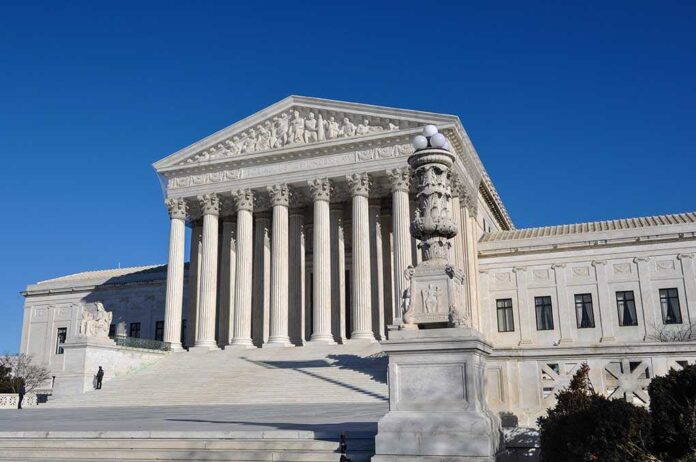
On January 14, 2026, the U.S. Supreme Court issued a 7-2 decision in Bost v. Illinois State Board of Elections, granting standing to Rep. Mike Bost (R-IL), presidential electors Laura Pollastrini, and Susan Sweeney. Chief Justice John Roberts authored the majority opinion, joined by Justices Thomas, Alito, Gorsuch, and Kavanaugh. The ruling reverses dismissals by the district court and Seventh Circuit Court of Appeals. Lower courts had rejected the suit for lack of standing, claiming no specific financial harm or likely election loss. This decision recognizes candidates’ inherent interest in election process integrity under federal law.
Judicial Watch Lawsuit Timeline
Judicial Watch filed the lawsuit on May 25, 2022, in U.S. District Court for the Northern District of Illinois against the Illinois State Board of Elections and Executive Director Bernadette Matthews. The case challenges Illinois law allowing mail-in ballots received up to 14 days after Election Day to be counted. Challengers cite federal statutes like 2 U.S.C. § 7 and 3 U.S.C. § 1 setting Election Day deadlines. Attorneys Robert Popper, T. Russell Nobile, Eric Lee, and counsel Paul Clement represented plaintiffs. Judicial Watch has removed over 5 million ineligible voters from rolls nationwide by May 2025, building momentum for this win.
🚨 BREAKING: Major win for election integrity at the Supreme Court this morning.
In a 7–2 ruling authored by Chief Justice John Roberts, SCOTUS said Rep. Mike Bost does have standing to challenge Illinois’ mail-in ballot policy, which allows ballots to be counted up to two weeks… pic.twitter.com/BhWDnXFeE6
— Digital Gal (@DigitalGalX) January 14, 2026
Key Statements from Victory
Judicial Watch President Tom Fitton declared the ruling “the most important Supreme Court election law ruling in a generation.” Rep. Bost called it a “critically important step for election integrity,” restoring trust eroded by loose mail-in rules. Chief Justice Roberts emphasized candidacy confers standing to protect fair processes, warning against post-election disputes. Justices Barrett and Kagan concurred but rejected special rules for candidates, favoring standard standing tests like financial harm. Justices Jackson and Sotomayor dissented, fearing it opens floodgates to litigation beyond any single election.
Under President Trump, this ruling aligns with renewed focus on secure elections after years of Biden administration laxity that fueled distrust. Conservatives long frustrated by extended deadlines—echoing 2020 controversies—see it as vital defense of constitutional voting principles. It empowers GOP candidates to enforce federal deadlines without bureaucratic hurdles.
Broader Implications for Election Integrity
The decision sends the case back to the Seventh Circuit for full merits review, potentially invalidating Illinois’ 14-day rule. It parallels a pending Mississippi case, granted review in November 2025, challenging a 5-day postmark extension by Libertarian and Republican parties. Short-term, candidates gain easier access to federal courts nationwide. Long-term, it reduces barriers to pre-election challenges but risks more lawsuits, as dissenters warn. States like Oregon and California face similar Judicial Watch suits on voter rolls, now advancing.
This victory bolsters family values and rule of law by ensuring elections reflect one day, one vote—not prolonged uncertainty favoring manipulation. Politically, it arms conservatives against globalist open-border mentalities bleeding into voting chaos. With Trump’s administration prioritizing sovereignty, expect tighter enforcement ahead of 2026 cycles.
Sources:
Supreme Court vote-counting ruling (Politico)
Supreme Court revives GOP lawmaker’s challenge to Illinois election law (Fox17/AP)
Supreme Court allows challenge to Illinois mail-ballot law counting (Washington Times)
Bost: Supreme Court Rules Bost Election Integrity Case Can Proceed (Riverbender)