

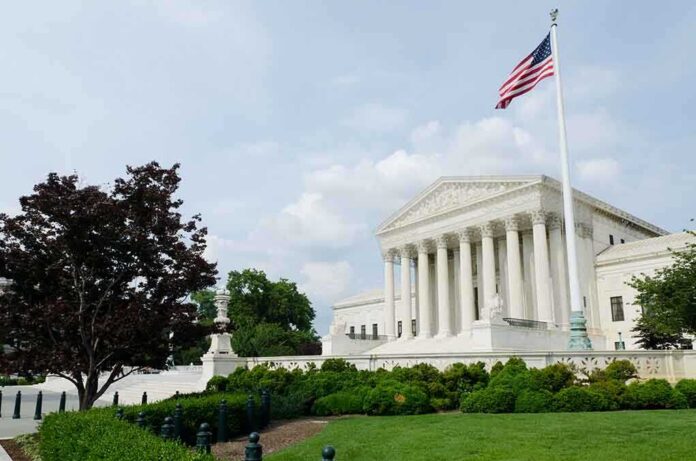
A Democratic state attorney general’s aggressive subpoena demanding donor identities from a pro-life pregnancy center network has reached the Supreme Court, threatening to expose conservative donors to harassment and potentially destroying First Amendment associational rights.
Story Highlights
- New Jersey Attorney General Matthew Platkin subpoenaed 10 years of donor records from First Choice Women’s Resource Centers
- Supreme Court heard oral arguments December 2, 2025 in landmark donor privacy case
- Case could determine whether nonprofits can protect supporters from government intimidation
- Ruling will affect all advocacy organizations nationwide, not just pro-life centers
Government Overreach Targets Pro-Life Organization
New Jersey Attorney General Matthew Platkin issued an extraordinarily broad subpoena in November 2023 demanding First Choice Women’s Resource Centers surrender a decade of internal documents, advertising records, and most alarmingly, the complete identities of all donors. This five-facility pro-life pregnancy center network became Platkin’s target after he issued a “consumer alert” in December 2022 warning against crisis pregnancy centers, claiming they mislead women about abortion services.
Platkin’s subpoena represents textbook government intimidation disguised as consumer protection. The Democratic attorney general claims donors might be confused about whether they’re supporting an abortion clinic versus a pro-life organization, despite First Choice’s website clearly identifying its pro-life mission. This pretextual argument falls apart under scrutiny, revealing the true purpose: exposing conservative donors to potential harassment and chilling future donations.
Constitutional Precedent Supports Donor Privacy
The Supreme Court’s 2021 decision in Americans for Prosperity Foundation v. Bonta directly undermines New Jersey’s position. That 6-3 ruling struck down California’s donor disclosure requirements, establishing that governments cannot engage in “dragnet collection” of donor information without proving necessity. Hundreds of nonprofit organizations across the political spectrum supported that case, recognizing donor privacy as fundamental to First Amendment associational rights.
Brett Nolan, Senior Attorney at the Institute for Free Speech, emphasized that the Supreme Court “made crystal clear” governments must prove donor disclosure is necessary before compelling such information. New Jersey has failed to meet this constitutional standard, instead relying on speculative claims about donor confusion that contradict readily available evidence about First Choice’s transparent pro-life mission.
Structural Bias Threatens Fair Adjudication
New Jersey’s political structure creates what Alliance Defending Freedom attorney Erik Baptist correctly identified as a “structural home-court advantage” for Attorney General Platkin. Governor Phil Murphy appoints both the attorney general and state judges, raising serious concerns about whether state courts can fairly adjudicate federal constitutional claims when the state itself is the opposing party. This federalism concern explains why First Choice seeks immediate federal court protection rather than exhausting potentially biased state remedies.
The 3rd Circuit Court of Appeals previously ruled First Choice’s case wasn’t “ripe” for federal review, requiring state court adjudication first. However, this procedural barrier ignores the chilling effect already occurring as potential donors reconsider supporting organizations targeted by hostile government officials. The mere threat of exposure creates constitutional harm requiring immediate federal intervention.
READ: “Wielding his vast power as attorney general, Platkin then targeted First Choice Women’s Resource Centers with an unfounded, unconstitutional subpoena demanding highly confidential private donor data”
Erik Baptist previews today’s case in @thehill https://t.co/YyGzcNKTPT
— Alliance Defending Freedom (@ADFLegal) December 2, 2025
This case extends far beyond one pro-life organization. The Supreme Court’s ruling will establish precedent affecting all nonprofits engaged in controversial advocacy, from educational institutions to civil rights organizations. A victory for government disclosure power would embolden Democratic attorneys general nationwide to weaponize subpoenas against conservative organizations, fundamentally undermining the independence of civil society from state interference.
Sources:
Supreme Court takes up pro-life pregnancy network’s fight for donor privacy
First Choice Women’s Resource Centers, Inc. v. Platkin
Institute for Free Speech Defends First Amendment Rights Against IRS Donor Disclosure Law
Supreme Court to Deliberate on Landmark First Amendment Case
Supreme Court hears subpoena dispute with anti-abortion pregnancy center