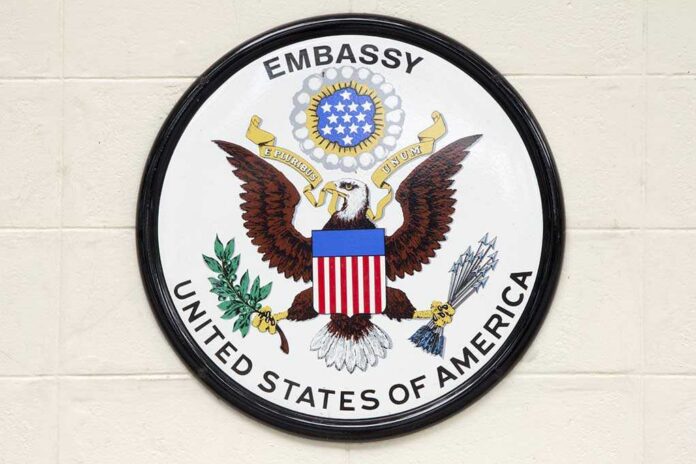
The U.S. State Department just authorized non-emergency personnel to flee the Jerusalem embassy, and if you think this is routine diplomatic housekeeping, you haven’t been paying attention to what’s brewing between Washington and Tehran.
Story Snapshot
- State Department authorized voluntary departures from Jerusalem embassy on February 27, 2026, citing unspecified “safety risks” amid U.S.-Iran tensions
- Ambassador Mike Huckabee urged staff to leave “TODAY” while commercial flights remain available
- Evacuation follows similar Beirut embassy departures and coincides with Trump’s military briefings on potential Iran strikes
- Decision creates stark contradiction with ongoing Geneva nuclear talks described as “positive” by Iranian officials
- Multiple nations including Australia, India, Brazil, and EU states issue parallel evacuation warnings across the Middle East
When Diplomats Run, Pay Attention
Embassy evacuations are diplomatic smoke signals, and this one carries the acrid smell of imminent conflict. The State Department’s February 27 authorization for non-essential U.S. government personnel and family members to depart Jerusalem wasn’t buried in bureaucratic language. Ambassador Huckabee’s email carried unmistakable urgency: leave today. When the U.S. ambassador to Israel tells his staff to catch the next flight out, he’s reading intelligence reports the rest of us won’t see for months, if ever. The carefully vague reference to “safety risks” omits the word everyone knows belongs there: Iran.
This evacuation mirrors the Beirut embassy departures earlier the same week, creating a regional pattern that suggests coordinated threat assessment across U.S. diplomatic posts. Commercial airlines noticed too. KLM canceled Tel Aviv flights starting March 1, making the State Department’s warning to leave “while commercial flights remain available” sound less like caution and more like countdown. The timing reveals Washington’s calculation: get Americans out before the shooting starts, but don’t say that part out loud.
The Twelve-Day War Still Casts Shadows
June 2025’s brief but brutal exchange between the U.S., Israel, and Iran established the playbook everyone’s consulting now. American and Israeli forces struck Iranian nuclear facilities. Iran responded with ballistic missile barrages targeting a major U.S. base and Israeli cities, including one that hit Tel Aviv. Tehran telegraphed those strikes with advance notice, allowing U.S. systems to intercept most missiles. That courtesy won’t necessarily repeat itself. Iran’s military spokespeople now warn that “reckless U.S. action” would ignite “widespread fire” across the region, and they’ve had nine months to restock their missile arsenal despite the damage sustained last summer.
President Trump ordered the massive Middle East military buildup last December, and Admiral Brad Cooper from U.S. Central Command briefed him on Iran strike options just one day before the embassy evacuation authorization. Trump’s State of the Union address on February 25 preferred diplomacy but explicitly kept military options on the table. The message was clear: we’ll talk, but our aircraft carriers are already in position. That’s not negotiation; that’s ultimatum wrapped in diplomatic niceties.
Geneva Talks Meet Military Reality
Here’s where the situation gets genuinely absurd. While Huckabee tells his staff to flee Jerusalem, U.S. envoys Steve Witkoff and Jared Kushner sat across from Iranian Foreign Minister Abbas Araghchi in Geneva for third-round nuclear talks on February 26. Araghchi described the discussions as showing “understanding” and “seriousness.” Omani mediators called them productive. Technical talks in Vienna were scheduled for the following week. So which is it? Are we on the brink of diplomatic breakthrough or military catastrophe? The answer appears to be both, simultaneously, which makes perfect sense in 2026’s Middle East calculus.
The Trump administration is pursuing what might charitably be called maximum pressure diplomacy or more accurately described as negotiating with a gun to Iran’s head. Vice President J.D. Vance downplayed risks of prolonged war, suggesting confidence that any military action would be swift and contained. That confidence ignores every lesson the Middle East has taught American presidents for the past fifty years. Wars that start with precision strikes have a nasty habit of metastasizing into decade-long quagmires involving proxies, militias, and regional powers with their own scores to settle.
The Cascade Effect Across Allied Capitals
Washington’s evacuation didn’t happen in isolation. Australia ordered diplomat dependents out of Israel, Lebanon, UAE, Qatar, and Jordan. India, Brazil, Singapore, and multiple European Union nations told their citizens to leave Iran immediately. China advised its nationals to depart Iranian territory. When this many governments simultaneously conclude their people need to leave the same region, they’re sharing intelligence that points toward the same conclusion: something bad is coming, probably soon. The coordinated nature of these warnings suggests the threat assessment isn’t just American paranoia but consensus among intelligence services that typically disagree on everything else.
The economic ripple effects have already begun. Airlines are canceling routes. Regional trade is freezing up. Israeli citizens face renewed anxiety about missile attacks after enjoying relative calm since last June. American personnel and their families are uprooting lives on days’ notice. Iranian civilians living near nuclear facilities know those sites remain prime targets. None of these people asked to be chess pieces in great power confrontation, but here we are. The human cost of this brinksmanship is already mounting before a single shot gets fired.
What Strength Actually Looks Like
The contradiction between diplomatic outreach and military evacuation reveals the fundamental challenge facing American foreign policy in the Middle East. Projecting strength doesn’t mean constantly threatening military action while simultaneously seeking negotiated settlements. Real strength would involve clear red lines, consistent messaging, and follow-through that doesn’t leave allies and adversaries equally confused about American intentions. Trump deserves credit for keeping military options available; deterrence requires credible threat of force. But evacuating embassy personnel while praising productive talks sends mixed signals that Iran can exploit.
Iran’s theocratic regime has survived four decades of pressure, sanctions, and isolation through a combination of ruthless internal control and skillful exploitation of Western inconsistency. They’re watching American diplomats flee Jerusalem while reading hopeful statements about Geneva negotiations and drawing their own conclusions about which signal to believe. The smart bet says they’re preparing for strikes while stalling in Vienna, buying time to disperse assets and harden defenses. Meanwhile, Hezbollah and other Iranian proxies are making their own calculations about when to activate if the shooting starts.
The Clock Nobody Can See
Embassy evacuations mark the final phase before military action in the modern diplomatic playbook. Governments don’t pull non-essential personnel without specific intelligence suggesting imminent danger. The State Department’s refusal to explicitly name Iran in the official advisory fools nobody; the entire region knows what “safety risks” means in this context. Commercial flight cancellations and allied evacuations confirm the assessment. What remains unknown is the timeline. Days? Weeks? The urgency in Huckabee’s message suggests days, but military buildups can maintain readiness for extended periods, and diplomatic channels remain technically open.
The American people deserve clarity about what their government is preparing to do and why. If Iran’s nuclear program poses an existential threat requiring military action, make that case directly instead of hiding behind vague safety warnings. If diplomacy still offers viable paths to preventing Iranian nuclear weapons, then explain why evacuating embassies while pursuing those paths makes sense. The current approach satisfies neither transparency nor strategic coherence. It leaves Americans, Israelis, and regional partners guessing about intentions while giving adversaries room to prepare for the worst.
Sources:
Axios – Trump faces decision on Iran war as U.S. evacuates Israel embassy
Middle East Eye – US allows non-essential staff to evacuate Jerusalem embassy
CBS News – U.S. warns diplomatic staff in Israel despite “positive” Iran nuclear talks in Geneva
The Jerusalem Post – US allows non-emergency staff to leave Israel embassy
U.S. Embassy in Israel – Travel Advisory February 27, 2026


![🇺🇸 First Lady Melania Trump Unveils New Fostering the Future & IndyCar Scholarships [LIVE]](https://ournationnews.com/wp-content/uploads/sites/26/2026/08/maxresdefault-43-218x150.jpg "Melania Speaks Out Amid Trump Aide Rumors")