
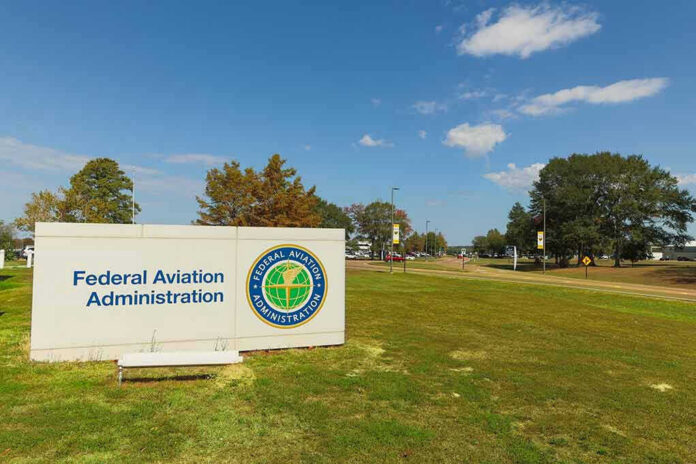
The nation’s aviation watchdog says the massive Trump arch will not foul Reagan National’s flight paths—and that single sentence resets the whole fight.
Story Snapshot
- The Federal Aviation Administration found no substantial adverse effect on Reagan National’s airspace.
- The agency said the arch needs red obstruction lights, a standard safety step for tall structures.
- The review to date points to no impact on visual or instrument flight procedures at the airport.
- A fuller Federal Aviation Administration study is still underway, leaving room for added conditions later.
What The Federal Aviation Administration Actually Concluded
The Federal Aviation Administration review said the proposed arch would not cause a substantial adverse effect on airspace use at Reagan National Airport. Reporters quoted the agency saying operations at the airport would not be harmed. The fix the agency called for is routine: place red obstruction lights on the top of the structure. Tall objects near airports often get this treatment. That is not a loophole. It is aviation safety 101, applied the same way across the country.
The agency’s early findings also pointed to no hit on visual or instrument flight procedures at Reagan National. That means pilots can still fly standard arrivals and approaches without a new penalty or reroute. The Federal Aviation Administration runs this analysis using runway geometry, approach surfaces, and exact coordinates. The rules trigger when a structure rises over 200 feet or sits inside protected airspace surfaces. The arch clears those tests with lighting in place, according to coverage of the study.
Why Lighting Mitigation Matters More Than Rhetoric
Red obstruction lighting is not window dressing. It turns a tall object into a known, charted, visible point for pilots and controllers. The Federal Aviation Administration often issues a “no hazard” or “no substantial adverse effect” finding with that single condition. Reuters and others noted the red-light callout here as standard for a 250-foot build near an airport. This is the same playbook used for cranes, towers, and stadium lights all over the map.
Some reports emphasize that the Federal Aviation Administration process has more steps ahead. That is true for many big projects near airports. The agency can add conditions, and in rare cases, change its view. But the existing statement carries weight. It signals that, under today’s data, the arch fits inside the safety margin with lighting. That is a practical, rules-based answer—not a political favor. The Federal Aviation Administration’s manuals focus on effects on operations, not vibes or headlines.
What Critics Are Arguing—and What The Record Shows
Opponents say the arch sits close to the north approach corridor and could add risk in crowded airspace. They point to low altitudes on final and a tight margin for pilot error. They also cite the intricate mix of landmarks, the river bend, and the Pentagon nearby. These points stress complexity, not a proven hazard. Even National Public Radio’s roundup conceded the arch itself likely does not pose a significant risk to most aircraft, which aligns with the agency’s finding.
The Trump administration, always so concerned about "freedom" and "common sense," was perfectly happy to push a 250-foot arch just two miles from a main airport runway, where planes land every minute. Aviation safety experts, people who actually understand flight paths and risk,…
— frakmaga2025 (@FrakMAGA2022) September 17, 2026
The New York Times and others mapped the corridor and raised alarms about clearance surfaces. That lens treats any intrusion as a red line. Federal aviation rules do not. An object can pierce an ideal surface yet still earn a green light after study if it does not harm a significant volume of operations. That is the heart of the Federal Aviation Administration standard. Results hinge on actual impact to procedures, not on a single geometric trigger alone.
The Common-Sense Read For Travelers And Taxpayers
The practical question is simple: Does the arch change how planes take off, land, or get cleared to fly there? The Federal Aviation Administration’s answer so far is no, once red lights are on. That lines up with a conservative, common-sense view: follow the rules, rely on the engineers, and apply the same safety tools to every project, no matter who backs it. If the final study adds limits, build those in. If not, let the project move ahead under the same standards used everywhere else.
What To Watch Next
Watch for the Federal Aviation Administration’s final determination letter and any added conditions. Look for clear specs on crane heights during construction and how crews stage equipment near the river. Expect the agency to publish the lighting plan with reference to its advisory circular. If new data changes the safety math, the Federal Aviation Administration can say so. Until then, the record says the arch, with red lights, does not disrupt Reagan National’s flight paths.
Sources:
cbsnews.com, npr.org, cyprus-mail.com, reuters.com, nytimes.com, cnn.com, govinfo.gov, fdotwww.blob.core.windows.net, faa.gov, americanbar.org
© ournationnews.com 2026. All rights reserved.