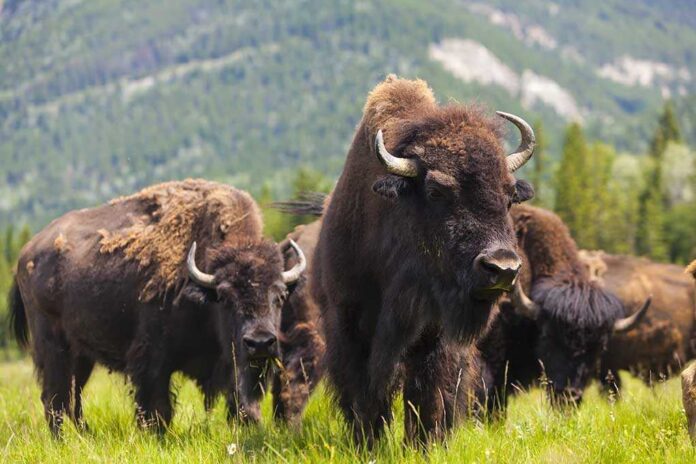
The most dangerous animal in Yellowstone is not the grizzly bear—it is the bison, and a 12-year-old just learned that the hard way.
Story Snapshot
- A 12-year-old was hospitalized after a bison encounter near Mud Volcano in Yellowstone.
- Officials say bison have injured more people in the park than any other animal.[2][10]
- Park rules require visitors to stay at least 25 yards away from bison and other large animals.[2][10]
- The cause of this encounter is still unclear, underscoring how fast a peaceful visit can turn dangerous.[3][8]
A calm morning turns into a hospital run
The story starts on a normal summer morning in one of the most popular spots in Yellowstone National Park. Around 9:15 a.m., near the Mud Volcano area just north of Fishing Bridge, a 12-year-old visitor crossed paths with a bison.[2] What happened in those few seconds is still under investigation, but the outcome is clear: the child was hurt badly enough to need an emergency trip to a nearby hospital.[2][5] Officials have not shared the child’s condition, which tells you this is not a simple scrape.[5]
Park officials say the child “sustained injuries” during the encounter, and emergency medical teams moved fast to get them to care.[2][5] The National Park Service has confirmed the time, location, and that it was a bison, not a bear or wolf.[2][5] That alone matters, because bison are not treated as cute photo props inside Yellowstone. They are a known public safety problem, backed by years of data showing they hurt more on-foot visitors than any other animal in the park.[2][10]
Why bison top the danger charts in Yellowstone
The National Park Service does not mince words: bison have injured more people in Yellowstone than any other animal.[2][10] Federal health data backs this up, showing bison have led pedestrian injuries in the park since 1980.[10] These are not freak events. In the 1980s, there were more than ten bison injuries per year. After the park pushed hard on safety education, that dropped to under one per year in the 2010s.[10] The main pattern is simple and sobering: people get too close, and the bison react.
Bison look slow and gentle from a car window, but they can run about three times faster than a human and will defend their space when they feel threatened.[2][3] Many past injuries happened when visitors walked up for photos only a few feet away, sometimes even turning their backs for a selfie.[10] American common sense says you do not walk up to a one-ton wild animal with horns for a picture. Yet time after time, people treat park wildlife like farm animals or zoo exhibits, and the consequences land them in the emergency room.
The rules are clear, but human behavior is not
The law in Yellowstone is clear and strict. Visitors must stay at least 25 yards away from bison and other large animals, such as elk, moose, deer, coyotes, and bighorn sheep, and at least 100 yards away from bears, wolves, and cougars.[2][10] Those numbers are not suggestions. They are legal limits written to stop exactly the kind of injury we just saw. Rangers repeat these rules at park entrances, on signs, and in every safety message they send.[10][6] When wildlife comes closer, the burden is on the human to move away and restore that gap.[2][6]
This latest incident fits that broader safety picture but leaves one key question hanging: did someone break those rules? A report quoting park officials says it is unclear how the animal was provoked.[3] The official Yellowstone release does not say whether the child was too close or whether the bison charged without warning.[2][5] No charges have been filed, and a rescue team mentioned in local coverage denies wrongdoing.[8] That mix of clear danger but unclear cause feeds public frustration: we know what bison can do, yet we do not know exactly what went wrong here.
Fear headlines versus real risk and responsibility
News outlets and social media feeds jumped on the story with sharp language about “rampaging bison” and “horror in Yellowstone.” Some YouTube channels leaned hard on fear to grab views, while others repeated that bison are “unpredictable” without explaining how human choices often set the stage for conflict.[1][11] The park’s own message focuses on distance rules and the fact that animals are wild and can be dangerous.[2][6] That is true, but it also risks sounding like the same warning people hear and ignore daily.
A 12-year-old was taken to an area hospital Friday after being hurt by a bison just north of Fishing Bridge in Yellowstone National Park. This is the first recorded bison attack in Yellowstone of the year.https://t.co/Y2PbY6AxKE
— Cowboy State Daily (@daily_cowboy) June 26, 2026
From a conservative, common-sense view, the core issue here is personal responsibility. Yellowstone is not a theme park. It is real wilderness with large, free-roaming animals. The government can post signs, set rules, and even close areas, but it cannot make every visitor act wisely. The data show that bison injuries almost always happen when someone moves inside the safety zone.[10] The best protection for families is not more fear or more regulation; it is teaching children and adults to respect that line and treat wildlife like the powerful, unpredictable creatures they are.
Sources:
[1] Web – 12-year-old hospitalized after being injured by bison in Yellowstone …
[2] Web – 12-Year-Old Child Attacked by Bison in Yellowstone National Park
[3] Web – Bison injures visitor in Yellowstone National Park on June 26
[5] YouTube – Bison injures 12 year old visitor in Yellowstone near Mud Volcano
[6] Web – 12-year-old hospitalized after encounter with bison at Yellowstone …
[8] Web – Yellowstone officials say a 12-year-old was injured after a bison …
[10] YouTube – 12-year-old injured by bison at Yellowstone National Park
[11] Web – Notes from the Field: Injuries Associated with Bison Encounters – CDC
© ournationnews.com 2026. All rights reserved.