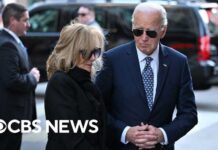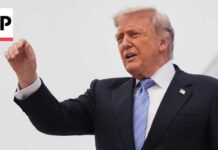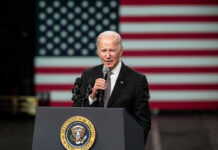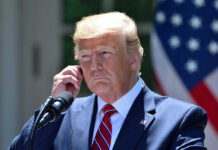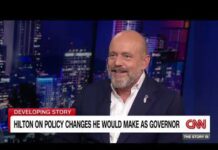
Trump escalated a Maryland feud into a military loyalty test, daring voters to decide whether Wes Moore criticized a president’s orders—or the uniform itself.
Story Snapshot
- Trump accused Maryland Governor Wes Moore of attacking the United States Air Force and the military, framing Moore’s legal critiques as anti-military rhetoric [1].
- Moore, a veteran and commander in chief of the Maryland National Guard, said service members should refuse unlawful orders, targeting legality, not troops [5].
- The clash sits atop a months-long feud over crime, immigration, and governance, where each side claims institutional high ground [1][2].
- The available record shows Moore disputing deployment authority and tactics rather than impugning the Air Force specifically [4][5].
Trump’s Charge: From Crime Debate To “Attack On The Military”
Donald Trump alleged that Governor Wes Moore attacked the United States Air Force and the military after Moore criticized Trump’s talk of troop deployments in American cities. The accusation repackages an ongoing personal and policy feud into a sharper institutional confrontation, where Trump casts Moore as undermining the armed forces’ reputation [1]. That tactic leverages the public’s reflexive respect for service members, converts a legal-policy disagreement into a cultural conflict, and rallies conservatives around defending the military’s honor.
Trump’s team has used this move before: reduce a multivariate policy dispute to a binary loyalty test. In Maryland, the background includes spats over immigration, a sewage spill in the Potomac, and public safety messaging [1][3]. When Moore objected to the idea of troops as a crime fix, Trump asserted that Moore’s pushback slighted the Air Force and the broader military. That leap shifts attention away from the legal limits of domestic deployments and toward a values-laden question: who really stands with the troops.
Moore’s Rebuttal: Law, Authority, And Respect For Service
Wes Moore answered from the rule-of-law lane, not the culture-war lane. He argued that orders he described as unlawful should not be followed, citing the long-standing military duty to refuse unlawful commands [5]. He emphasized his status as a military veteran and as Maryland’s commander in chief of the National Guard, underscoring respect for service members and their families. That framing separates criticism of a civilian leader’s directives from any slight against the people in uniform who would be forced to execute them [5].
Moore’s television appearances align with this legalistic posture. In a national interview responding to Trump’s attacks on Maryland’s crime record, Moore rejected the premise that troop deployments solve street-level disorder and steered instead toward targeted federal help, funding, and law enforcement coordination, not boots on Baltimore corners [4][2]. The record in these clips supports a policy dispute over scope and legality, not a targeted attack on the United States Air Force as an institution [4].
What The Evidence Shows And What It Does Not
The public clips capture Moore calling certain proposed orders unlawful and unacceptable, which opponents can recast as hostility to “military conduct.” That rhetorical gap fuels Trump’s claim. However, the materials tie Moore’s comments to deployment authority, not to disparagement of the Air Force specifically [4][5]. The feud’s breadth—immigration, infrastructure, crime—creates a fog where a sharp allegation can outpace the paper trail, and social summaries often drop the legal explanations voters need to evaluate the claim [1][2][4].
President Donald Trump said Maryland Gov. Wes Moore is delaying a planned renovation of "dilapidated" golf courses at Joint Base Andrews, arguing the project would benefit military personnel and wounded veterans. https://t.co/kX2QobrXEb
— FOX Baltimore (@FOXBaltimore) June 6, 2026
The stronger case rests with facts that survive partisan framing. First, Moore rooted his critique in the lawful-orders principle that every service member learns, which accords with conservative respect for chain of command and constitutional limits [5]. Second, he argued for federal aid calibrated to crime’s causes rather than a show-of-force deployment, a fiscally conservative preference for targeted tools over grand gestures [2][4]. Third, none of the cited exchanges documents Moore attacking the Air Force as a separate entity, which weakens Trump’s specific accusation [4][5]. Voters should demand primary-source receipts whenever rhetoric jumps from legal boundaries to claims of anti-military animus.
Sources:
[1] Web – NEW: Trump SLAMS Maryland Governor Wes Moore for “Attacking the United …
[2] Web – Tensions rise between President Trump and Maryland Gov. Wes …
[3] Web – Pres. Trump calls out ‘foul mouthed’ Gov. of Md., feud grows, revives …
[4] YouTube – Trump blasts Maryland Gov. Moore over Potomac sewage spill
[5] YouTube – Gov. Wes Moore responds to Trump’s attacks against him
© ournationnews.com 2026. All rights reserved.