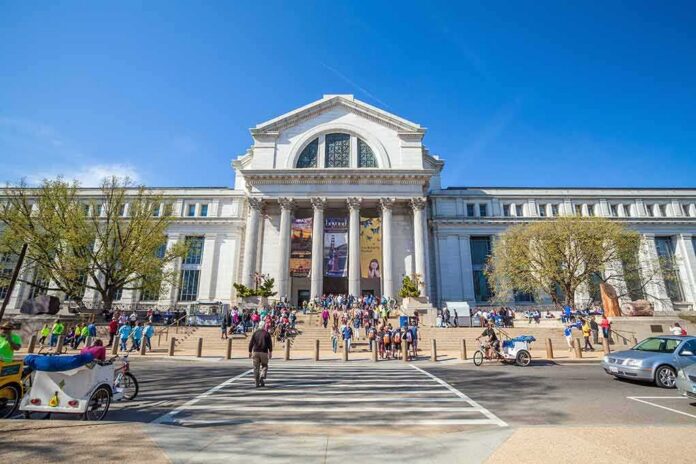
The White House ordered warning signs outside America’s flagship history museum, turning the Mall into the next battlefield over who tells the nation’s story.
Story Snapshot
- President Trump directed temporary warning signs outside the National Museum of American History.
- The order says museum leadership shifted from history to ideology and needs public notice.
- A White House report accused the museum of “extreme political activism” and previewed sharp sign language.
- Plans showed roughly a dozen signs and an estimated $84,000 cost, with designs not yet final.
What the Order Demands, Plain and Simple
The July 24 directive told the Department of the Interior to install warning signs outside the National Museum of American History. The signs would steer visitors to administration findings and point to “accurate information” resources approved by the White House. The order’s backbone is a White House Domestic Policy Council report that says the museum moved away from a coherent story of America and toward political activism. One draft line even warned the museum’s curators “don’t want you to love your country”.
The plan did not die on paper. Internal planning showed the National Park Service preparing about a dozen signs around the building, with a projected cost of $84,000. Officials described the signs as temporary and said final text was pending, but the budget lines and placement concepts existed. That detail matters. It signals an operational push, not just a cultural shout. The signs would greet families before they ever reached the ticket desk and shape how many saw the exhibits that day.
Why the White House Says the Museum Lost Its Way
The administration argues the museum downplays achievement and unity and leans into a narrow, accusatory frame of America. The White House report criticized content clusters on race, gender, sexuality, environmental change, and immigration as evidence of ideological capture, not balanced history. Reuters summarized the report’s charge as “thinly veiled anti-Americanism” and “extreme political activism”. The goal of the signs, in this view, is consumer protection: warn visitors, then route them to countervailing facts.
This is a conservative argument about stewardship, not censorship. Museums funded by taxpayers should tell the whole story—warts, triumphs, failures, and renewal—without preaching. If exhibits train children to see their country mainly as villain, that fails civic education. A label does not ban a display. A label says, read more, compare, and decide. That is common sense in an age when people accept “surgeon general warnings” on less consequential things than history.
Pushback From the Smithsonian and Its Allies
Smithsonian Secretary Lonnie G. Bunch III rejected the White House report’s portrayal. He said the assessment was not a fair read of the museum’s full body of work and admitted only that “there will always be room for improvement”. Coverage also noted the report’s hot-button language, citing claims about “anti-White activism,” “illegal alien activism,” and “transgender activism.” It said the report faulted materials on white supremacy, racism, slavery, conquest, and exclusion—topics many historians say belong in any full account of the past.
etter from Interior Secretary Doug Burgum revealed new details about warning signs the White House will install near the American-history museum.”
The Next Change Trump Has Planned for the Smithsonianhttps://t.co/evZrjArDpR
— A_Gabriel (@AGabrielresists) September 16, 2026
Two things can be true at once. The museum can responsibly cover hard chapters of race and exclusion, and curators can still tilt tone and emphasis in ways that shape public feeling. The sharpest critics of the signs risk sounding like they fear outside scrutiny. That stance can backfire. If leadership stands by its work, it should welcome side-by-side comparisons, publish sources, and let Americans weigh the record. Confidence in the truth does not hide from a placard at the door.
What to Watch Next: Substance Over Slogans
Specifics, not slogans, will decide how this lands. The clearest path is sunlight. Release the White House report in full with exhibit citations. Publish the museum’s line-by-line responses with primary documents. If the signs go up, make their text factual and measured, not taunting. The Atlantic reported that designs were not final; overreach in tone will look like propaganda, not guidance. Get the tone right, and the signs could spark curiosity rather than rage-clicks.
Sources:
washingtonpost.com, washingtonblade.com, washingtonexaminer.com, cnn.com, theatlantic.com, newsweek.com, fox5dc.com
© ournationnews.com 2026. All rights reserved.