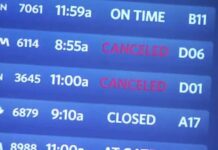
President Trump’s threat to deploy Immigration and Customs Enforcement agents to overwhelmed airports exposes a government shutdown crisis that has left TSA workers unpaid for nearly two months while spring break travelers suffer through security lines stretching past two hours.
Story Snapshot
- Trump threatened Monday ICE deployment to airports unless Democrats approve DHS funding, with 376 TSA officers already resigned since February shutdown began
- Major airports report wait times exceeding 150 minutes as unpaid TSA workers face second month without paychecks, next pay period approaching March 27
- ICE agents lack airport security training requiring months to complete, raising questions about effectiveness beyond crowd control assistance
- Bipartisan negotiations with Border Czar Tom Homan described as productive, though specific contents of new DHS funding proposal remain undisclosed
The Shutdown Stranglehold on Airport Security
The Department of Homeland Security shutdown began February 14, triggering a staffing hemorrhage at Transportation Security Administration checkpoints nationwide. At least 376 TSA officers quit their posts as paychecks vanished, while those who remained worked without compensation during peak spring break travel season. George Bush Intercontinental Airport in Houston clocked security wait times reaching 150 minutes. Hartsfield-Jackson Atlanta International, the world’s busiest airport, saw lines exceeding two hours on Saturday morning alone. LaGuardia and Miami International airports experienced delays stretching 35 to 45 minutes as call-out rates climbed among financially strained workers.
TSA leadership warned that small airports may face temporary closures if agent absences continue their upward trajectory. The timing compounds the crisis, as millions of travelers navigate spring break plans through understaffed security checkpoints. Some airports scrambled to support unpaid workers, with Atlanta providing meal vouchers, free parking, and public transportation to sustain operations. The March 27 pay period looms as the next pressure point, threatening to accelerate resignations among essential personnel classified as required to work despite the funding impasse.
ICE Deployment Threat as Legislative Leverage
Trump’s Saturday Truth Social posts escalated the standoff with definitive language: “I look forward to moving ICE in on Monday, and have already told them to, ‘GET READY. NO MORE WAITING, NO MORE GAMES!'” The deployment threat specified arrests of “all Illegal Immigrants” with heavy emphasis on Somalis, citing concerns about Minnesota. This conflates immigration enforcement with airport security operations, creating operational ambiguity about ICE’s actual role. Republicans suggested limited assistance potential, with Senator John Kennedy acknowledging ICE could help manage crowds to free TSA officers for screening duties, though he cautioned this wouldn’t be dispositive without rapid training.
Democrats rejected the deployment framing entirely. Senate Minority Leader Chuck Schumer called for immediate TSA funding decoupled from ICE reform negotiations: “Let us keep negotiating the outstanding issues with ICE, but let us start sending paychecks to TSA workers now.” Senator Richard Blumenthal argued ICE should obey the law rather than be deployed helter-skelter as an all-purpose police force. The positions reveal fundamental disagreement over whether immigration enforcement agencies belong in transportation security roles, particularly when those agents lack the months-long training TSA officers complete before certification.
The Training Gap That Threatens Security Integrity
George Borek, an Atlanta TSA officer and union steward, articulated the core operational problem: “What it takes to be a TSA officer, a certified officer, to be able to do screening takes weeks and months to do. The president can have them come there but I don’t see how that helps us in getting through this time period.” His concern extends beyond inconvenience to security vulnerabilities. Untrained personnel don’t know what they’re looking for during screening, potentially creating gaps that compromise passenger safety. This reality limits ICE agents to supplementary functions like line management and passenger direction rather than primary security screening.
The training requirement exposes the deployment threat as more political pressure tactic than operational solution. ICE agents could theoretically assist with crowd control to allow trained TSA officers to focus on screening checkpoints, but this represents marginal relief rather than substantive resolution. Senate Majority Leader John Thune expressed hope that a deal would make ICE deployment unnecessary, acknowledging the limited utility of bringing in personnel who lack specialized airport security expertise. The fundamental problem remains TSA staffing levels depleted by resignations and financial hardship among workers continuing without paychecks.
Negotiation Progress Amid Public Pressure
Bipartisan lawmakers met with Border Czar Tom Homan Friday night in sessions described as productive by Senate Majority Leader Thune. The Trump administration submitted new legislative text on DHS funding, though lawmakers have not publicly disclosed specific contents. Additional weekend meetings were anticipated as the Monday deployment deadline approached. Democrats control funding authority leverage but face mounting public pressure from airport disruptions affecting millions of travelers. Republicans remain divided on ICE deployment strategy, with some supporting limited assistance roles while others question the approach’s effectiveness and appropriateness.
The negotiations highlight institutional vulnerabilities in critical infrastructure funding mechanisms. TSA workers classified as essential personnel continue working without compensation while their colleagues resign at accelerating rates. The shutdown coincides with peak travel season, amplifying operational strain and public visibility. Small airports face potential temporary closures if staffing deteriorates further, threatening to cascade disruptions beyond major hubs. The crisis demonstrates how funding impasses create ripple effects across interconnected government agencies, with immigration enforcement and transportation security becoming entangled in ways that satisfy neither operational effectiveness nor legal clarity about appropriate agency roles.
Sources:
TIME Magazine – ICE Airports TSA Wait Times
KRDO – Trump Threatens to Deploy ICE Agents to Airports Monday if Funding Deal Isn’t Reached
LA Taco – Trump Moves to Leverage ICE Deployment at Airports Amid DHS Funding Dispute
ABC News – Trump Threatens to Put ICE Agents at Airports Starting Monday