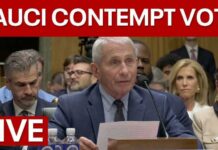

A Senate committee’s contempt referral and a hundred-plus Fifth Amendment invocations now shadow Anthony Fauci’s legacy more than any photo ever could.
Story Snapshot
- Senators voted along party lines to refer contempt charges against Fauci to the Department of Justice.
- Fauci invoked the Fifth Amendment more than 100 times during a subpoenaed hearing.
- Republicans argue a presidential pardon removed federal risk and undercut his privilege claim.
- Democrats call the process partisan and say the Justice Department will decide what happens next.
What The Committee Actually Did
The Senate Homeland Security and Governmental Affairs Committee voted to recommend contempt charges against Fauci and to refer the matter to the Department of Justice. The vote split along party lines after a tense hearing about the pandemic, research funding, and records handling. The referral is not a conviction. Prosecutors must still decide whether to bring a case. That gap matters because contempt of Congress charges are rare to prosecute and hinge on facts and privilege law.
Committee Republicans said Fauci refused to answer core oversight questions tied to the government’s pandemic decisions and to research risks. They argued Congress has a duty to trace how grant money flowed and how choices were made. They framed the refusal as noncompliance with a lawful subpoena, not a good-faith legal stance. This is the heart of the contempt theory: a willful block on answers the public paid for and deserves to hear.
Why The Fifth Amendment Fight Matters
Fauci invoked the Fifth Amendment more than 100 times during the session, according to multiple outlets that covered the hearing and aftermath. Republicans said a presidential pardon erased any real federal exposure, so the privilege should not apply. They also claimed Fauci waived the privilege by making an opening statement before refusing questions, though that claim remains disputed in legal commentary and news reports. The waiver question could drive the Justice Department’s decision either way.
Democrats and legal analysts counter that a pardon’s scope can be complex. They say it may not cover all possible risk, including potential state exposure or conduct after the pardon. They also argue a short opening statement does not automatically waive rights. These arguments do not erase the referral, but they do frame a road the Justice Department must navigate if it takes up the case.
The Oversight Stakes Beyond The Spectacle
Republicans said the inquiry focuses on pandemic policy choices, the path of taxpayer money, and whether risky research overseas had any link to the crisis. They cited the need to test claims about the Wuhan Institute of Virology, gain-of-function questions, and record retention. They also highlighted refusals to even basic questions to argue the Fifth Amendment claims were blanket rather than narrow, which would support contempt under common-sense oversight standards.
Partisanship clouds the picture. The vote broke by party, and Democrats said the process was rushed and one-sided. That narrative makes it easy for some to dismiss the referral as theater. But the recorded vote, the subpoena, and the on-camera refusals are not theater props; they are the file the Justice Department must weigh. Conservative principles say government power needs straight answers, especially after a crisis that scarred families, schools, small businesses, and trust.
What Comes Next And What To Watch
The Justice Department now decides whether to prosecute under the contempt statute. That call likely turns on three questions. First, did the questions fall within a valid zone of potential self-incrimination despite the pardon? Second, did Fauci’s brief opening statement waive any privilege? Third, was the invocation narrow and tailored or broad and obstructive? Clear answers require transcripts, the subpoena text, and the pardon instrument—documents that were not publicly detailed in the media snapshots.
Process is not a punchline. If prosecutors decline, Congress can still press for documents, seek limited-use immunity, or reconvene with tighter question sets that box in privilege. If prosecutors proceed, the court will test the privilege claim and the waiver theory. Either way, the right lesson is discipline: follow the money, test the science claims, preserve records, and fix the rules so the next crisis does not rely on trust without verification. That is how oversight earns respect again.
Sources:
nypost.com, yahoo.com, c-span.org, cnn.com, npr.org
© ournationnews.com 2026. All rights reserved.