The most jarring part of the Columbus Circle jogger crash is how fast “routine police response” turned into a viral question about who gets to bend the rules of the road—and at what cost.
Story Snapshot
- A New York Police Department patrol car reportedly responding to a theft smashed into a jogger in Columbus Circle, caught in a viral clip.
- Police framed it as an emergency response collision; critics argue the record is too thin to treat it as a justified risk.
- The clash fits a wider pattern where police driving is defended as necessary until hard data finally emerges.
- The real fight is over who carries the burden of caution when lights, sirens, and split-second decisions collide with everyday pedestrians.
How a Theft Call Turned Columbus Circle Into a Crash Scene
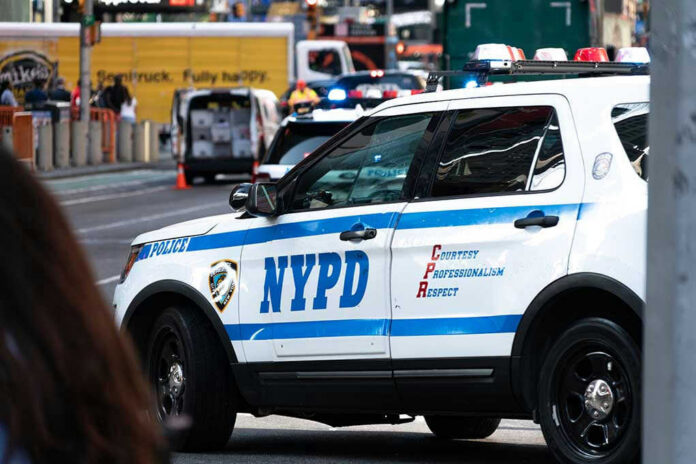
New Yorkers saw the headline and then the clip: a New York Police Department vehicle, said to be racing to a reported theft near Columbus Circle, slams into a jogger in broad daylight while traffic crawls and pedestrians do what they do every day—try to stay alive in the crosswalks. That “responding to a crime” framing matches a familiar pattern. Police statements tend to arrive first, usually emphasizing urgency and danger while the actual records sit sealed behind bureaucracy and delay.
Around 3pm today, a NYPD vehicle responding to an emergency near Columbus Circle was traveling against traffic with emergency lights and sirens activated. A pedestrian unexpectedly entered the roadway in front of the cruiser, resulting in a collision. pic.twitter.com/7v661rdEFD
— TheSalGreco (@TheSalGreco) May 31, 2026
Local coverage and social posts traced the basic outline: officers on an emergency run, a theft call nearby, the cruiser maneuvering hard, then the impact with a pedestrian in the roadway. One community alert simply logged it as a vehicle collision in Columbus Circle, with little else besides time and place, a reminder of how bare the official public record can be at first blush.[2] Into that vacuum, the wild video surged, and viewers did what viewers do: rewind, zoom, and assign blame.
The Emergency-Response Defense And What It Actually Proves
Police defenders lean on a core claim: the officers were not joyriding; they were doing exactly what taxpayers expect—responding quickly to crime. That argument matters because most states, including New York, give emergency vehicles limited latitude to exceed speed limits, run lights, or drive contra-flow when they operate with due regard for public safety. The key words are “limited” and “due regard.” The badge gives extra powers, not a blank check, and the law still requires a higher standard of care, not a lower one.
The difficulty is that “we were on an emergency” answers a different question than “were you driving safely?” The first is about mission; the second is about execution. Without hard proof of siren use, light activation, speed, braking, and traffic-signal phase, treating the mission as a free pass rewards narrative over evidence. For conservatives who value both law and order and personal responsibility, that distinction is not academic. The same government that enforces traffic tickets on ordinary drivers does not earn trust if it shields its own from scrutiny on the roadway.
What We Still Do Not Know About the Jogger’s Fate
The uncomfortable truth is that the public does not yet have the raw materials needed to say definitively whether this crash was a tragic but lawful risk or an avoidable failure of judgment. There is no released dash camera or body camera video showing the exact entry into the intersection, no dispatch audio clarifying whether this call met the department’s own emergency criteria, and no collision reconstruction detailing speed or evasive maneuvers. Even the jogger’s legal status in the roadway—crosswalk, signal, right of way—remains publicly undefined.
NYPD patrol car collides with jogger while responding to reported theft in Columbus Circle: wild videohttps://t.co/oE0ywPIUxZ
— BREAKING NEWZ Alert (@MustReadNewz) June 3, 2026
That information gap does not stop either side from talking. Some critics assume excessive speed and reckless cross-traffic driving. Police supporters assume the jogger stepped out heedlessly or that all consequences are acceptable if officers chase thieves. Both leaps run ahead of the evidence. A better conservative instinct is to demand the basics: release the Computer-Aided Dispatch log, the 911 call, any available event-data-recorder output, and the traffic-signal timing so the discussion moves from vibes and viral clips to facts and timelines.
The Bigger Pattern: Sirens, Split-Second Choices, And Public Risk
This case fits a pattern that shows up again and again in big cities. Studies and news archives are full of emergency-vehicle crashes where the first coverage leans heavily on “pursuit,” “emergency call,” and “suspect at large,” while the last thing to arrive is a full accounting of how the vehicle was driven.[1] Official explanations tend to emphasize the danger of the suspect or the urgency of the call, not the danger created by adding another fast, heavy object to already crowded streets.
From a common-sense view, the logic is simple: the same city that lectures residents about speed cameras and traffic-calming owes them straight answers when its own agents create the hazard. That does not mean handcuffing officers from chasing violent criminals or ignoring the reality that seconds can matter. It does mean distinguishing between a life-or-death pursuit and a property crime where shaving thirty seconds off the response time does not justify threading a cruiser through dense pedestrian zones at high risk. That balance is where policy, not just public anger, has to land.
What Accountability Should Look Like After the Video
Reasonable people can hold two thoughts at once: police work is dangerous and necessary, and government power on the road must be tightly disciplined. A serious response to the Columbus Circle crash would not start with press-spin about “wild video” and viral outrage; it would start with automatic release of collision files, radio traffic, and any available vehicle data within a defined window unless a clear investigative need requires delay. Anything less invites suspicion that the story is being massaged after the fact.
There is also a cultural piece. When officers know that every emergency run will be second-guessed not just on whether they arrived, but on how they got there, they have an incentive to treat the steering wheel as a responsibility, not a shield. That is not anti-police; that is pro-accountability and pro-innocent-bystander. Columbus Circle is a symbol of New York’s hustle, not a proving ground for government immunity. The jogger on that video paid the price for someone else’s risk calculus. Taxpayers deserve to know exactly whose.
Sources:
[1] Web – NYPD patrol car collides with jogger while responding to reported …
[2] YouTube – 10 people seriously injured after NYPD patrol car crashes …
© ournationnews.com 2026. All rights reserved.