
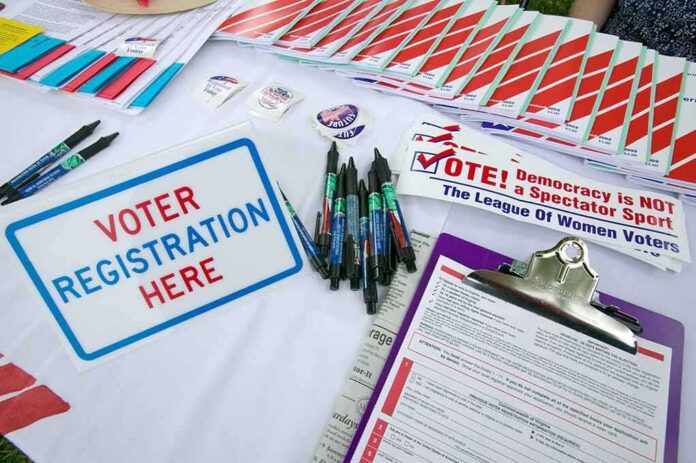
Four Republican senators just handed Democrats their second straight win against a bill that asks voters to prove they are American citizens before casting a ballot in federal elections.
Story Snapshot
- The Safeguard American Voter Eligibility (SAVE) America Act failed again in the Senate after four Republicans crossed the aisle to block it alongside Democrats.
- Senators Lisa Murkowski (Alaska), Thom Tillis (North Carolina), Susan Collins (Maine), and a fourth Republican colleague sided with the Democratic caucus to deny the bill the votes it needed to advance.
- The bill would require documentary proof of U.S. citizenship, such as a passport or birth certificate, to register to vote in federal elections.
- Opponents claim more than 21 million eligible Americans lack ready access to the required documents, while supporters argue noncitizen registration is a real and documented threat to election integrity.
What the SAVE America Act Actually Does
The Safeguard American Voter Eligibility (SAVE) America Act would amend the National Voter Registration Act to require documentary proof of citizenship at the time of voter registration for federal elections. [8] That means a passport, birth certificate paired with a photo ID, or a comparable document proving the applicant is a U.S. citizen. The bill’s co-author, Senator Mike Lee, argues the requirement is straightforward common sense, pointing to an affidavit fallback provision for voters who cannot produce documents, which he says neutralizes the poll-tax comparison his critics favor.
Supporters point to Department of Homeland Security reviews they say identified tens of thousands of noncitizens registered to vote in multiple states. Opponents counter that noncitizen voting is already illegal under federal law and that confirmed cases are rare. Neither side has yet produced a comprehensive, independently audited dataset that settles the numerical dispute. What is not disputed is that the bill would override current federal law, which explicitly prohibits states from requiring documentary proof of citizenship under the National Voter Registration Act. [16]
Why Four Republicans Broke Ranks and Killed the Bill
The four Republicans who voted to block the bill, Murkowski, Tillis, Collins, and a fourth colleague, did not leave a unified public statement explaining their collective reasoning. What the vote does reveal is a fault line inside the Senate Republican conference that has now stopped the SAVE America Act twice. [2] Senate Majority Leader John Thune faced direct questions about whether he would simply allow a vote he knew would fail, a dynamic that exposed just how fragile the bill’s coalition remains even within his own caucus.
The practical objections raised by election administration specialists deserve a fair hearing regardless of partisan affiliation. The Bipartisan Policy Center identified five concrete implementation problems, including the bill’s potential to require major overhauls to existing registration systems and expose election officials to criminal and civil penalties if they make procedural errors. [11] Those are legitimate governance concerns, not simply left-wing talking points. Whether those concerns outweigh the integrity argument is a separate question, but Republican senators citing them are not obviously acting in bad faith.
The Access Argument Is Real, Even If It Is Overplayed
The Brennan Center for Justice claims more than 21 million eligible American citizens do not have documentary proof of citizenship readily available. [9] That figure comes from an advocacy organization with a clear institutional position, so it warrants scrutiny. But the underlying data point, that a meaningful percentage of eligible voters lack a passport or certified birth certificate on hand, is not implausible. The United States passport ownership rate has historically hovered around 40 to 50 percent of the adult population, meaning the document most commonly cited as qualifying proof is simply not in the hands of a large share of the electorate.
McConnell and Tillis are gone. Get rid of Murkowski in the general election – make her wish she hadn't played games with ranked voting, and elect other Republican Senators so that Collins is irrelevant.
BREAKING: Senate Votes 48-50 to Reject SAVE America Act – FOUR Republicans…
— Patrick Casey (@PatrickJCasey) June 5, 2026
The affidavit fallback provision Senator Lee cites as the answer to this problem has not been analyzed in detail by independent election law scholars in the materials available here. That gap matters enormously. If the affidavit option is genuinely workable, the access objection weakens considerably. If it creates its own administrative maze, the concern is legitimate. Congress owes voters a line-by-line public accounting of how that provision functions before the bill advances, and the fact that supporters have not made that case in granular public detail is a strategic failure on their part. [15]
The Integrity Argument Deserves Better Evidence Than It Is Getting
Supporters of the SAVE America Act are making an argument that resonates with a wide swath of the American public. Polls consistently show strong majority support for voter ID requirements in the abstract. The White House has publicly backed the legislation. [12] But the specific claim driving the bill’s urgency, that noncitizen registration is happening at scale and undermining federal election outcomes, requires harder evidence than has been placed in the public record. FOIA requests targeting the underlying Department of Homeland Security review methodology and state-by-state registration audit data would either validate the concern or expose it as inflated. Until that evidence is public and independently verified, the integrity argument rests on assertion rather than proof.
The four Republicans who blocked this bill may have made a defensible procedural judgment, a bad political calculation, or both simultaneously. What is clear is that the SAVE America Act will not become law without either flipping those four votes or replacing them. The bill’s supporters need a sharper evidentiary case and a more detailed public defense of its implementation mechanics. Without both, the same four senators will make the same call next time, and the outcome will be identical. [7]
Sources:
[2] Web – The SAVE Act Status: Congress takes up even worse anti-voter bills
[7] Web – SAVE Act Successfully Stalled in Senate as a Result of Tireless …
[8] Web – In Victory for Voters, the SAVE America Act Fails in the Senate
[9] Web – The SAVE Act is the Wrong Solution for a Non-Problem
[11] Web – Stand Up AGAINST The SAVE Act – Rock the Vote
[12] Web – Five Things to Know About the SAVE America Act
[15] Web – On the floor to talk about why I’m voting against the SAVE Act. |…
[16] Web – Explainer: SAVE, SAVE America and MEGA Acts – Issue One
© ournationnews.com 2026. All rights reserved.