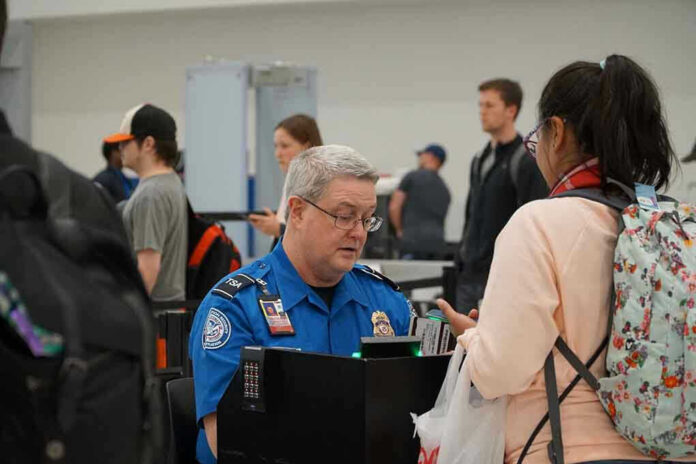
Starting February 1, 2026, unprepared air travelers without REAL ID-compliant identification now face a mandatory $45 fee every time they want to fly domestically—a stark evolution from warnings to wallet-draining enforcement that changes airport security forever.
Story Snapshot
- TSA’s new ConfirmID system charges $45 for a 10-day verification window, replacing previous warning-based enforcement for travelers without REAL ID-compliant identification
- The fee represents a 150% increase from the initially proposed $18 charge announced just three months earlier in November 2025
- Travelers must complete online verification at TSA.gov before arriving at airports, with no guarantee of checkpoint clearance even after payment
- Full enforcement arrives May 5, 2027, when alternative verification options disappear and non-compliant travelers face outright denial of airport access
From Security Measure to Revenue Stream
The REAL ID Act emerged from the ashes of September 11, 2001, with Congress enacting legislation on May 11, 2005, to establish minimum security standards for state-issued identification. Twenty years of delays, state resistance, and pandemic extensions transformed what should have been a 2008 implementation into a protracted saga of bureaucratic postponements. Now, as enforcement finally crystallizes, the government has discovered a lucrative revenue opportunity disguised as a security accommodation. The ConfirmID fee structure suggests this is less about helping unprepared travelers and more about incentivizing compliance through financial pressure.
The $45 Question Nobody Asked For
The TSA announced its modernized alternative identity verification process in November 2025 with an $18 fee. By February 2026, that price jumped to $45—a 150% increase with minimal explanation. This non-refundable charge buys travelers exactly 10 days of airport access, barely enough to cover a round-trip vacation before expiration. Frequent business travelers without REAL ID face hundreds or thousands in annual fees, creating a de facto penalty system for non-compliance. The fee covers multiple flights within the 10-day window, but the narrow validity period makes clear this is designed as temporary relief, not a sustainable alternative.
No REAL ID yet? You can still fly, but it may cost $45 without another form of accepted ID https://t.co/8VSaao5Uu6
— The Boston Globe (@BostonGlobe) January 31, 2026
Steve Lorincz, TSA Deputy Executive Assistant Administrator for Security Operations, made the system’s limitations explicit: even after completing online verification and paying the fee, TSA officers retain full discretion to deny checkpoint access if they cannot verify identity in person. Travelers gamble $45 on a non-refundable fee with zero guarantee they will actually board their flight. The verification process itself demands 10-15 minutes online, supplemented by potential 30-minute-plus in-person screenings at security checkpoints. This administrative burden falls heaviest on elderly travelers, low-income families lacking easy DMV access, and marginalized communities already facing identification barriers.
Acceptable Alternatives to the Fee Trap
Not everyone faces the ConfirmID cash register. U.S. passport holders, military ID cardholders, and anyone who secured their REAL ID from their state DMV sail through security checkpoints without additional fees or friction. All 50 states, the District of Columbia, and five U.S. territories now issue REAL ID-compliant licenses and identification cards, typically marked with a star symbol. The documentation requirements include proof of identity, Social Security number verification, and lawful status confirmation—a reasonable security standard that nonetheless creates obstacles for undocumented immigrants and individuals without stable housing or access to vital records.
The Enforcement Escalation Timeline
May 7, 2025, marked the beginning of flexible enforcement, with TSA allowing warnings instead of outright travel denials through May 5, 2027. This grace period was meant to ease the transition and give procrastinators time to visit their DMV. Instead, TSA introduced the ConfirmID fee system barely nine months into the grace period, monetizing the accommodation phase rather than maintaining it as a no-cost transition. Come May 5, 2027, the financial penalty transforms into absolute prohibition—non-compliant travelers without approved alternative identification will simply be denied access to domestic flights. The escalation timeline reveals a clear strategy: warnings, then fees, then denial.
Who Benefits From This System
TSA gains a new revenue stream potentially worth millions annually if even 20-30% of the traveling public relies on ConfirmID verification. Airlines receive operational headaches from increased checkpoint processing times but publicly support REAL ID as a security enhancement. State DMVs face surging demand for REAL ID applications without corresponding federal funding increases to handle the volume. The clear winners are compliant travelers with REAL ID or passports, who bypass fees and delays entirely. The clear losers are low-income Americans, elderly citizens with limited mobility, and anyone who postponed DMV visits expecting continued free warnings rather than fee-based workarounds.
TRAVEL TROUBLES: Beginning Sunday, air travelers in the U.S. without a REAL ID or another acceptable form of identification, such as a passport, are subject to a new fee. https://t.co/g843fMnzA4
— WPLG Local 10 News (@WPLGLocal10) January 31, 2026
The broader implications extend beyond airports. REAL ID establishes federal standards for state identification, requiring electronic databases, fraud prevention programs, and digital image storage that represent significant state investments in surveillance infrastructure. The precedent of fee-based alternative verification could expand to other federal facilities, creating tiered access systems where compliance status determines both convenience and cost. This model fundamentally alters the relationship between citizens and government identification requirements, transforming security standards into revenue opportunities and administrative barriers into profit centers. Whether this serves the traveling public or merely extracts payment from the unprepared remains the $45 question.
Sources:
REAL ID – Airlines for America
REAL ID Required for U.S. Travelers Beginning May 7, 2025 – Department of Defense Travel
REAL ID – Pennsylvania Department of Motor Vehicles